U.S. Bank sends its own stablecoin across the Atlantic. The bank’s rules are decisive
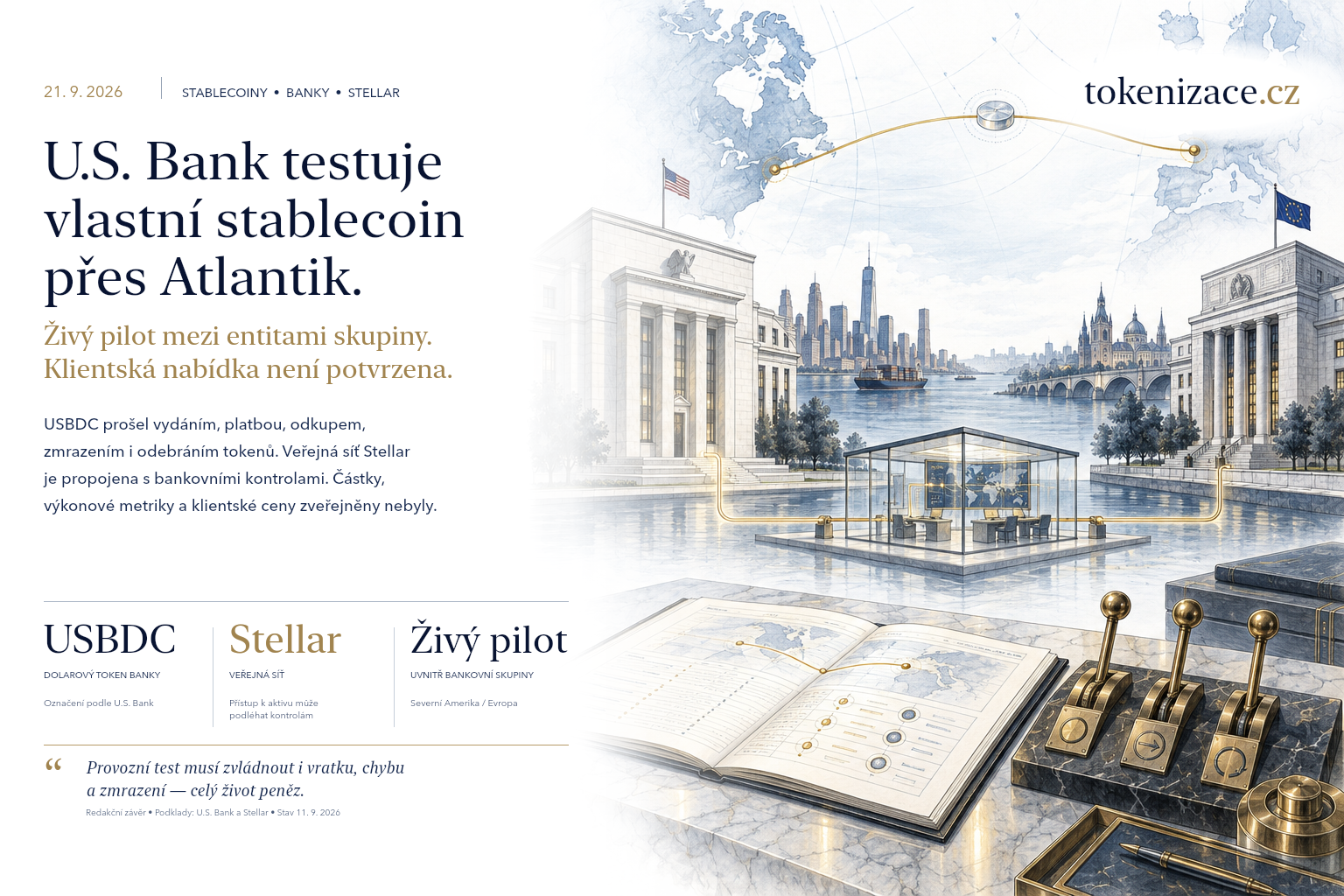
On 9 September, U.S. Bank announced a live cross-border test of its own USBDC dollar stablecoin between its entities in North America and Europe on Stellar. The test covered issuance, transfer, redemption, freezing and clawback, and integration with the bank’s internal management. Volume, corridor, savings and conditions for customer use were not published. A functioning pilot is therefore not a finished public service.
Take the full article to your ChatGPT, Claude or Gemini and explore what it means for your work.
A bank transfer is usually judged by whether the money arrived. With a digital token that can circulate on a public network, the opposite direction must also be examined: who can stop it, who confirms redemption and what happens when an error occurs. This is precisely why U.S. Bank’s announcement about its own USBDC stablecoin deserves attention.
On 9 September, the bank announced a live cross-border test between its own entities in North America and Europe on the Stellar network. It involved its own dollar token and integration with banking systems. The public announcement does not yet describe a product that an ordinary corporate customer could order. Nevertheless, it offers Czech and Slovak businesses a concrete guide to the questions to ask about a similar service.
Summary for readers
- U.S. Bank tested an actual transfer of its own stablecoin between two parts of its group on the public Stellar network.
- The test covered issuance, transfer and redemption, as well as interventions in the token. The focus is integration with the bank’s financial, risk and operational management.
- The transfer amount, exact corridor, savings and conditions for customer use were not published. A functioning pilot therefore cannot be confused with a finished public service.
1. What was actually tested
U.S. Bank describes USBDC as its dollar-backed stablecoin. The test ran on its own digital asset platform, connected to the bank’s financial, risk, compliance and operational systems. The announcement explicitly mentions token issuance, payment, redemption, freezing and clawback. The bank is exploring further use in liquidity management, collateral and cross-border treasury.
This is more than a point of interest for the payments department. If a new form of money does not enter accounting, limits and controls with the same discipline as other assets, it creates a parallel operation alongside the bank. Integration is therefore among the most substantively important parts of the announcement.
At the same time, we do not know the number of repetitions, volume or exact form of the transaction. The announcement cannot be used to calculate the speed of the entire banking process or its economic return. What is verified is that the described test took place; measurable commercial results have not been published. A table of actual operational results would be more useful for further assessment than another general promise of speed.
2. The bank’s own group offers an important but limited test
A transfer between affiliated entities has value: different parts of the bank must align their systems and confirm the creation and extinguishment of the relevant balances. The bank can set the participants and commercial circumstances itself. This difference from an open service matters when interpreting the outcome. Stellar’s statement likewise describes a specific cross-border banking pilot, not a general customer rollout.
An external business brings additional questions. It may want to pass the token to a supplier, hold it outside the banking interface or need redemption while the bank is dealing with an unusual event. A contractual relationship, support, liability for an incorrect instruction and partners’ differing levels of operational readiness are added.
Meaningful continuation of the pilot should therefore also test movement across organisational boundaries. Who confirms receipt, how is a misallocated payment traced and how long does correction take? These are our editorial questions for the next phase, not information about a bank plan that has not been announced.
3. A public network permits controlled access to an asset
A blockchain’s public nature describes the infrastructure. The issuer also determines the rules for the particular token. Stellar’s documentation permits prior approval of holders to be required and transaction authorisations to be revoked. Technically, an asset can therefore operate on a public network with a restricted set of recipients.
For a company, this means that a compatible wallet does not yet guarantee access to money. Holder registration, contractual conditions and current permissions also matter. Separating these layers helps avoid a practical mistake: a technically prepared recipient need not be an authorised recipient of that product.
When introducing it, a business should verify all participants’ permissions before the first significant payment. For recurring suppliers, it also matters how a status change affects orders and obligations falling due. A tool that can reject a transfer needs an understandable error explanation and a person to resolve the resulting situation. Simply waiting for the blockchain will not remedy such a problem.
4. Freezing and removal are different interventions
Freezing restricts further use of a balance. Stellar’s clawback function allows the issuer of an appropriately configured asset to remove a specified quantity of tokens from a holding. The documentation describes it as destroying those units; it is not a general reversal of time across the entire network.
The two options have different operational meanings. Where there is suspicion, it may first be necessary to stop movement. A permanent intervention in a balance, however, requires an answer about what happened to the legal claim and how the change is reflected in accounting. The technical ability to intervene does not itself determine who may approve it or on what grounds.
A company should know the procedures for notification, handling a mistake and any review in advance. The bank, in turn, needs to separate those who propose, approve and technically carry out an intervention. This division is our proposed operational standard, not USBDC’s published organisational structure. The quality of digital money is also demonstrated by how predictably it works in an unpleasant situation.
5. Continuous transfers are not the same as continuous treasury
In its commentary, Stellar emphasises the network’s properties and the ability to process digital value without traditional time restrictions. General network parameters, however, are not a measured duration for a specific banking transaction.
A chief financial officer needs to see the entire timeline. When is an approved instruction sent, when is the token created, when can the recipient use it and when can money be obtained in the required bank account? Even a very fast middle section may wait for a check, liquidity or accounting confirmation.
The benefit should be measured from the business need to a usable balance. Alongside time, it makes sense to track tied-up liquidity and total costs, including handling exceptions. For a small company, predictable receipt of payment may matter more than technically shortening a transfer by a few seconds. Conversely, for a group moving large amounts, rapid availability of funds can be highly valuable. The announced pilot does not yet allow these benefits to be quantified.
6. The US framework does not replace a specific authorisation
In March 2025, US supervisor OCC confirmed the permissibility of certain stablecoin activities and banks’ participation in distributed networks. Letter 1183 also removed the previous special supervisory non-objection process under Letter 1179. The relevant activities nevertheless remain subject to ordinary supervision and requirements for safe and sound operations.
This framework explains why a bank can explore such technology. It does not establish individual approval of every USBDC parameter. The bank’s public press release does not attach such a regulatory decision.
The GENIUS Act further establishes specific rules for payment stablecoins, their issuers, reserves and redemption. To assess a particular product, however, the precise legal entity, nature of the liability and applicable regime must be known. The term “bank stablecoin” alone does not replace this information.
At this stage, specific holder protection therefore cannot be assigned to the token solely on the basis of the U.S. Bank brand. Commercial trust in the institution matters, but contractual documentation must define precisely which claim arises from owning the token.
7. Redemption determines how a digital balance returns to company operations
The BIS distinguishes the stablecoin model from tokenised bank deposits partly by how they circulate and how conversion at par is ensured. A token’s name is therefore insufficient to decide how to classify it within a company’s cash holdings.
For business operations, the key is whether the company has a direct right to redeem, within what period it can exercise it and where it receives the money. Selling a token to another interested party addresses a different situation from returning it to the issuer. The company needs to know which route will remain available when demand for cash rises.
Conditions also include the currency needed for its own obligations. A dollar token may suit dollar payments; Czech payroll or a euro invoice, however, must be funded in the relevant currency. Conversion costs and exchange rate risk do not disappear when a balance is digitised. Without published USBDC conditions, it is impossible to calculate whether it would help a specific company or how much money that company might hold in it.
8. What a Czech or Slovak customer needs to see
If a similar dollar token were publicly offered in the European Union as a token referencing a single official currency, MiCA’s rules on electronic money tokens would enter the assessment. These address, among other things, issuer authorisation and rights at issuance and redemption. A transfer between two group entities does not itself establish the existence of such a European offering.
For an initial decision, a company should obtain a specific product document naming the contractual counterparty and setting out rules for access, redemption and interventions in the balance. This should be followed by testing accounting treatment and operational support within its own payment chain. Only then does comparing time and price with the existing solution make sense.
U.S. Bank has shown that it is testing its own digital money with intervention functions and integration into internal management. The next significant step will be evidence of an available service and its conditions. Readers can then ask a very specific question: if a transfer fails, who takes responsibility and when will the money be usable again?
Links and sources
Ledger Insights — U.S. Bank cross-border pilot, 9. 9. 2026
U.S. Bank — Launches USBDC Stablecoin, 9. 9. 2026
Stellar — A bank-issued stablecoin moves real money on Stellar
Stellar Docs — Asset Design Considerations
Stellar Docs — Clawbacks
OCC — Bank Authority to Engage in Certain Cryptocurrency Activities, 7. 3. 2025
OCC — Interpretive Letter 1183, 7. 3. 2025
U.S. Congress — GENIUS Act, Public Law 119-27
BIS — Stablecoins versus tokenised deposits, Bulletin 73
EUR-Lex — MiCA, Regulation (EU) 2023/1114, Title IV
Methodological note
The source cutoff is 11 September 2026; 21 September is the planned publication date. The text draws on primary announcements and documents that were opened. General Stellar functions and legal frameworks are not presented as USBDC’s published configuration, individual authorisation or contractual conditions. The specific amount, corridor, costs, reserve documentation and customer availability are not stated in the announcement examined. Proposed operational measures and control questions are editorial analysis.
Basis of the article: the author’s text draws on U.S. Bank’s announcement of 9 September, statements by the Stellar Development Foundation, the network’s technical documentation and US and European primary legal sources. Ledger Insights serves as an editorial lead. The description of the completed pilot is separated from our own analysis of banking controls and the possibilities of a future customer product.
This article is for information and educational purposes. It is not legal, investment, tax or regulatory advice, nor a recommendation to buy or use a stablecoin. The token’s legal nature, holder protection and service availability depend on the specific structure and contractual conditions.
What this means for you
AI puts the article in the context of your role, company and industry. Choose the one working document you need now.
Saved outputs and notes are private. Making your profile public does not share them with other users.
Loading account…
Context and outlook
Loading…
Open the full category →Comments
No comments yet. Be the first!
Recommended reading
Related reading based on this article’s topic and category.