Six Canadian banks are preparing tokenised deposits. Shared technology does not mean a shared debtor
BMO, CIBC, National Bank, RBC, Scotiabank and TD are exploring a shared approach to tokenised Canadian-dollar deposits. OSFI has confirmed a technology-neutral approach; CDIC insurance is assessed case by case.
Take the full article to your ChatGPT, Claude or Gemini and explore what it means for your work.
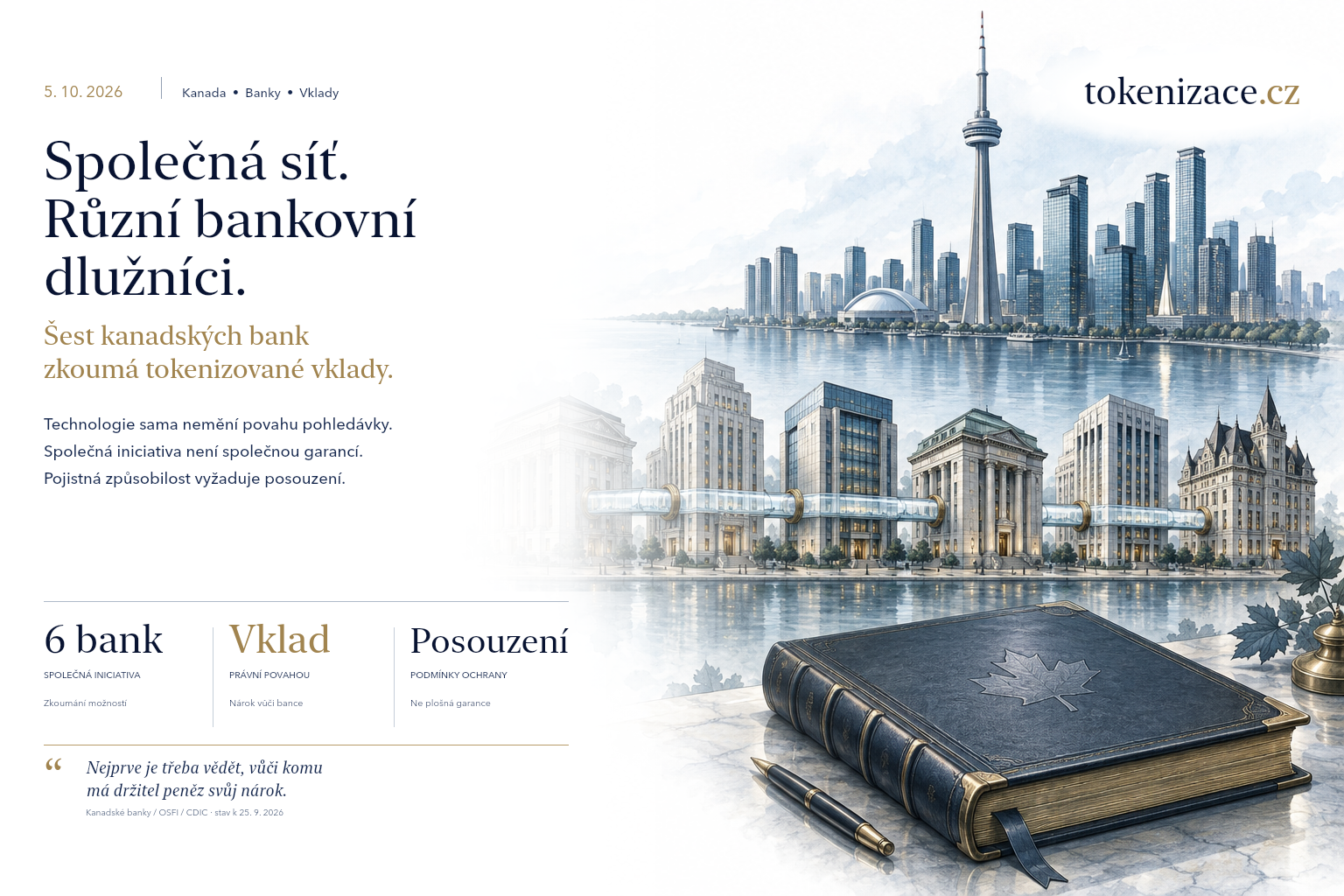
Six major Canadian banks want to explore a shared solution for tokenised Canadian-dollar deposits. The announcement follows an important clarification by the supervisor, OSFI: technology alone does not determine a financial product's legal nature. Under this approach, a tokenised deposit does not cease to be a deposit simply because it is recorded differently.
For the customer, however, a fundamental question remains, one sometimes overshadowed by shared technology projects. At which bank does the customer hold a claim, what happens to it during a transfer, and on what terms is it protected? Shared infrastructure can connect institutions, but it does not itself create one common bank balance sheet.
Summary for readers
- BMO, CIBC, National Bank of Canada, RBC, Scotiabank and TD announced exploration of a tokenised deposit solution; they did not announce a service already launched.
- OSFI confirmed a technology-neutral approach and financial institutions' responsibility for their suppliers' activities as well.
- CDIC assesses innovative products' eligibility for insurance individually. Neither the word “deposit” nor the involvement of a major bank establishes unlimited protection for every digital balance.
Transfers between banks first
The joint announcement published by TD on 22 September describes exploration of Canadian digital money solutions, beginning with tokenised deposits. The first phase is to examine their efficient movement between Canadian financial institutions. The longer-term perspective envisages connections with other digital asset initiatives and potentially bringing in additional deposit-taking institutions.
The banks did not announce a specific public launch date, final architecture or pricing. The precise status is therefore joint preparation. Nor can naming six participants be confused with proof that each already offers customers the same product on identical terms.
Coordination between multiple banks nevertheless matters. A company generally does not transact only with counterparties holding accounts at the same institution. The usability of a new payment format therefore also depends on whether it can move beyond the boundaries of one banking application while preserving understandable rights for both sender and recipient.
OSFI separates legal substance from technical implementation
OSFI's statement of 10 September says that the underlying technology does not, by itself, determine a product's legal nature. For tokenised deposits, it states that they do not differ legally from traditional deposits. It also reiterates institutions' responsibility for the legal compliance of their activities, including activities performed by third parties on their behalf.
The supervisor expects communication with the responsible supervisory contact before new products are launched and refers, among other things, to B-13 on technology and cyber risk and B-10 on third-party risk. This is therefore not an announcement that a new way of keeping records removes existing control requirements.
For the customer, the practical consequence is the need to read the contractual relationship. Who accepts the money? Who has an obligation to return it? Who maintains the authoritative record? “A platform of six banks” is too general an answer for this check. Each claim must be attributable to a specific arrangement.
Insurance is assessed separately
Canada's deposit insurer, CDIC, expressly states that innovative products, including tokenised deposits, may qualify for protection depending on how they are designed and offered. Assessments are made case by case under the statutory conditions. Member institutions should address this issue during development, including situations where an intermediary enters the relationship.
This is precisely where general confirmation of a deposit's legal nature differs from a specific conclusion on the scope of protection. A product may use a familiar banking brand and still require clarification of who is the recorded depositor or in which category the claim is held. The applicable limits and other conditions do not disappear because a customer signs in to a digital wallet.
The article does not assess insurance for the six banks' planned service. Its final terms are not disclosed in the announcement. It highlights a separate question that will need answering before actual use.
What it means to transfer a deposit to another bank
In an ordinary payment, a customer sees an amount debited and credited. Settlement simultaneously takes place between institutions. Canada's Lynx system is an example of existing infrastructure for high-value payments with real-time final settlement. A new digital solution enters an environment that already has rules for obligations and finality.
The technological architecture of tokenised deposits can be designed in different ways. The customer should nevertheless always understand whether, during a transfer, they continue to hold a claim against the originating bank or a new claim arises against the recipient's bank. We present this distinction as an analytical question; the joint announcement does not describe the specific mechanism.
It is equally important to separate confirmation that an instruction has been received from final settlement. A user interface may bring the two moments visually close, but contracts and operating rules must define their actual meaning. For a business with several banking counterparties, this affects both exposure management and available cash.
Canada has experience from a different type of experiment
In March 2026, the Bank of Canada described Project Samara, a limited real-world experiment involving the issuance of an Export Development Canada tokenised bond and wholesale central bank digital money. RBC and TD participated as joint lead managers of the issuance.
Samara is important context, but it is not identical to September's six-bank initiative. It involved a different instrument, a different purpose and a closed group of investors. Its successful completion does not establish the availability of a general customer network for tokenised bank deposits.
Such distinctions help prevent several separate projects merging into the impression of an already completed market. Each experiment must be assessed according to what it actually performed and which parts of operations remained outside its scope.
For companies, clarity of the banking relationship is decisive
A Czech or Slovak business with a Canadian trading partner should assess a potential new service against the same needs as any other banking route: currency availability, costs, predictable settlement and rights against a specific institution. The Canadian interpretation does not automatically carry over into European law.
Before introducing new records, it makes sense to request a clear description of the full transfer between two banks, including failure or cancellation. Who owes the money at each stage, and who handles a complaint? What documentation will accounting receive? Will access to records remain available if the technology supplier changes?
September's Canadian announcements create a sound foundation for further development: banks are seeking a shared route and the supervisor is explaining that legal responsibility continues. The next decisive information will be in the specific product terms. Those will show whether the new technical format actually simplifies payments while preserving a clear relationship between bank and customer.
Sources
Methodological note
The joint bank announcement documents the project's preparation; the legal approach and insurance assessment have separate primary sources in OSFI and CDIC. We do not assume an architecture, launch date or specific insurance coverage that has not yet been disclosed. Questions about the banking relationship are editorial interpretations. The sources were verified as of 25. 9. 2026, rather than the future publication date.
Disclaimer
This article is for information and education. It does not constitute legal, investment, tax or regulatory advice, or a recommendation of any particular product or provider.
What this means for you
AI puts the article in the context of your role, company and industry. Choose the one working document you need now.
Saved outputs and notes are private. Making your profile public does not share them with other users.
Loading account…
Context and outlook
Loading…
Open the full category →Comments
No comments yet. Be the first!
Recommended reading
Related reading based on this article’s topic and category.