SEC opens a new way to trade shares. Actual shareholder rights are a condition
The SEC has issued a temporary conditional exemption for trading tokenised NMS stocks through automated liquidity pools. Matching the price is not enough: an eligible token is to preserve the rights of a traditional share.
Take the full article to your ChatGPT, Claude or Gemini and explore what it means for your work.
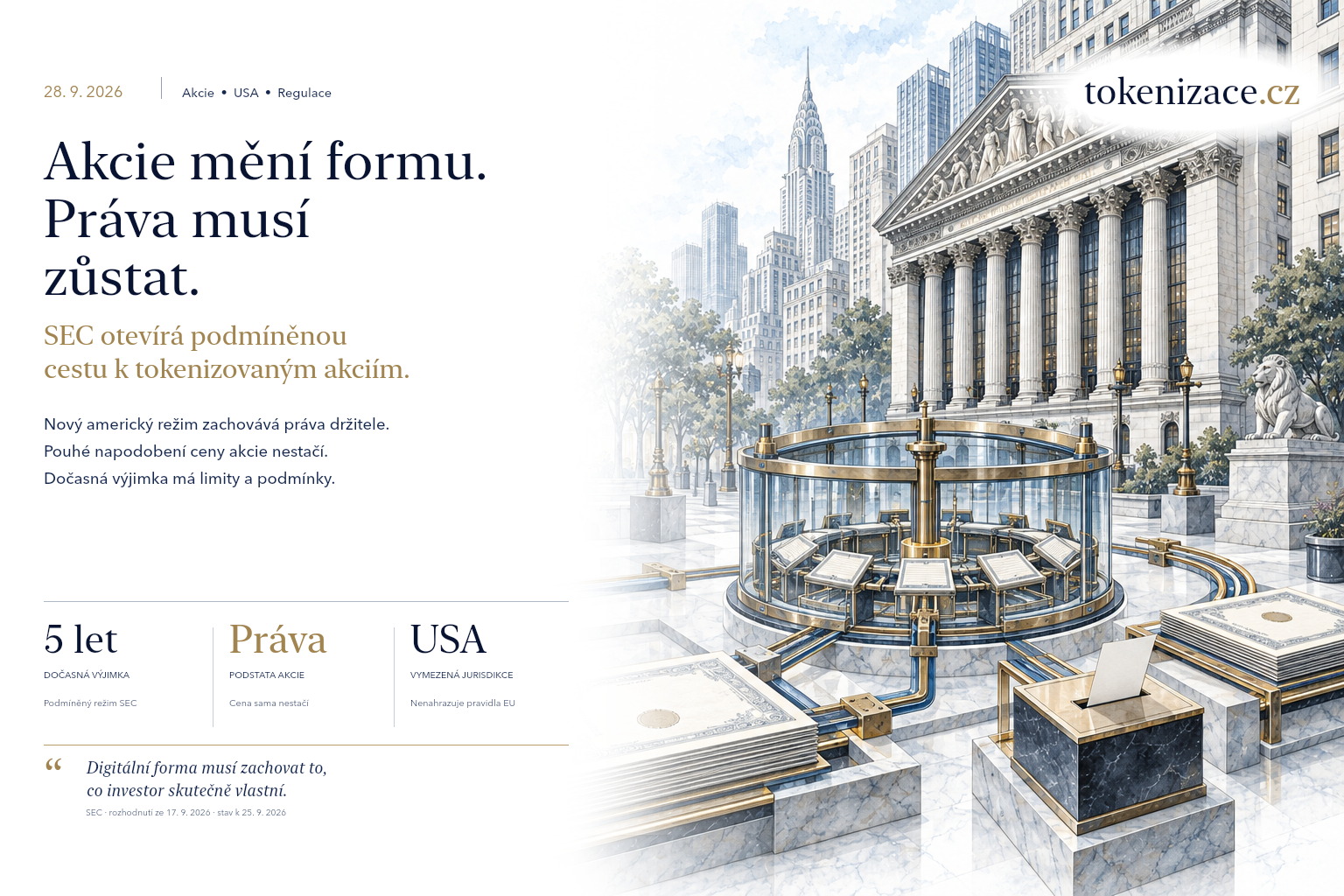
A token with the same price as a share need not give its owner the same rights. This very question lies at the heart of a new US exemption for trading tokenised shares. Under specified conditions, the SEC allows the use of automated mechanisms familiar from digital markets. At the same time, it requires that what the investor actually buys is not lost along the way.
For a Czech or Slovak company, the protection of the instrument’s substance is more interesting than the technology itself. A new trading route may differ from an existing exchange, but it still needs a precisely identified owner, a transfer of rights and rules for unusual situations. September brings a specific American experiment, not universal permission to issue shares as arbitrary tokens.
Summary for readers
- The SEC has issued a temporary conditional exemption for certain platforms and liquidity providers trading tokenised NMS stocks through automated liquidity pools.
- The same price is not enough. An eligible token is to preserve rights corresponding to a traditional share; a synthetic replication of its returns falls outside this regime.
- For a European company, the decision represents an important direction of development. It does not replace European rules for financial instruments or assessment of a specific offering.
What the SEC actually permitted
The SEC’s press release of 17 September describes two related forms of relief: for Tokenized Securities Venues, or TSVs, from the definition of an exchange, and for specified liquidity providers from the definition of a dealer. The basis is trading certain tokenised NMS stocks, meaning instruments of the US National Market System, using automated market makers and liquidity pools.
The relief is conditional and limited to five years. Among other things, the announcement requires controlled participant access, public auditable contracts on a public blockchain, operational transparency and simultaneous trading halts when trading in the underlying stock is suspended on its primary market. This is therefore a specific way of organising trading. The announcement does not establish that the SEC has approved every service that adds tokenisation to its name.
An automated liquidity pool can be understood as an environment in which price and trade execution are governed by a predetermined mechanism and available assets. It works differently from matching buy and sell orders in a traditional order book. Even an automatic mechanism, however, does not create an unlimited number of counterparties or unlimited money. The cost of a trade also depends on the amount of available liquidity and the size of the order.
A right to dividends cannot be replaced by a similar price chart
The January statement by SEC staff distinguishes tokenisation by the issuer from third-party models. For a third party, this may involve a record of a direct or indirect interest in a security held in custody, but also its own instrument that merely replicates another asset’s returns. The statement is SEC staff interpretation, not a new Commission rule.
For an investor, the difference is fundamental. With one product, voting and entitlements associated with the underlying share are at issue. With another, the investor may primarily hold a contractual claim against a provider promising an economic outcome linked to the share price. A similar chart in an application says nothing about this difference. There is also the question of what happens to the claim if the intermediary becomes insolvent.
The SEC’s September decision excludes synthetic replication of the underlying instrument from the definition of an eligible tokenised NMS stock. For shares tokenised by an unaffiliated third party, it additionally requires notice to the original issuer. Trading cannot begin earlier than 30 calendar days after delivery, and the issuer can object within that period. Equal rights are therefore more than a promise on a platform’s marketing page.
A smaller experiment needs precise boundaries
The decision limits both the number of symbols traded and the share of trading volume. For Tier 1, it specifies no more than 75 symbols and 0,25 per cent of the relevant stock’s average daily volume over the preceding month; for Tier 2, the limits are 250 symbols and 2,5 per cent. The rules also cover aggregation across affiliated TSVs. The precise methodology appears on pages 23–25 of the decision.
These boundaries have commercial significance. A platform must decide which instruments to include in its offering and whom it will serve. Limited capacity also means that a legal possibility cannot, without more, be interpreted as a mass migration of the US equity market. For a business plan, the distinction between an available regime and the volume a particular service can actually accommodate is fundamental.
Commissioner Hester Peirce places the exemption in the context of the search for further ways to trade on blockchain. Mark Uyeda notes the role of temporary exemptions in developing market models. These are their publicly expressed views. The decisive operational conditions must still be sought in the decision itself.
A trading platform is only one part of the chain
When an investor submits an order, price and trade confirmation matter to them. But the issuer must also ensure an accurate list of entitled persons, voting materials, dividend payments and the handling of corporate actions. Tokenisation needs to connect these processes. Otherwise, a fast trading screen emerges behind which employees continue to reconcile inconsistent records manually.
A separate SEC staff letter concerning DTC from December 2025 addresses the depository’s pilot tokenisation service within a specific scope. It is not the same as the September exemption for TSVs. Its existence shows why record-keeping and custody must be distinguished from the trading venue itself. Permission for one function cannot automatically be extended to the entire supply chain.
Similarly, the joint capital FAQs of US banking regulators are based on identical legal entitlements for eligible tokenised securities. The technological format generally does not change capital treatment, but it does not relieve a bank of risk management. This is another piece of infrastructure, not a promise that every token will be equally acceptable collateral for a bank.
What a Czech or Slovak company should assess
The US development does not provide a Czech issuer with an automatic route to American investors. A company must first determine which security it is offering, to whom, through which intermediary and under which legal regime. Only then does choosing a technical environment make sense. The reverse approach may produce a finished token with no usable distribution route.
In Europe, Article 2 of MiCA excludes crypto-assets qualifying as financial instruments from the scope of that regulation. ESMA’s guidelines emphasise a technology-neutral assessment. The token label therefore creates no separate shortcut around capital market rules.
A practical product review should begin with a document linking the digital record to a specific entitlement. This is followed by verification of the party responsible for records, voting and payments, the ability to transfer outside the application and the procedure if it fails. With a third party, it is also necessary to understand how the underlying shares are held and the consequences of that party’s failure. This question has value even before the first demonstration of the user interface.
The new US regime opens up scope for competition over better trading arrangements. Its long-term value will depend on whether new services preserve clear rights while providing usable liquidity, reasonable costs and well-managed operations. For an issuer, this combination matters more than the number of blockchains on which its shares appear.
Sources
Methodological note
The legal parameters are based on the SEC’s decision; public statements by individual commissioners and staff are identified according to their status. The practical implications for issuers are editorial interpretation. We do not assess the eligibility of any specific platform or claim that the exemption proves its launch, liquidity or security. The status of sources was checked as of 25. 9. 2026, not the future publication date.
Disclaimer
This article is for information and educational purposes. It does not constitute legal, investment, tax or regulatory advice, nor a recommendation of any specific instrument or provider.
What this means for you
AI puts the article in the context of your role, company and industry. Choose the one working document you need now.
Saved outputs and notes are private. Making your profile public does not share them with other users.
Loading account…
Context and outlook
Loading…
Open the full category →Comments
No comments yet. Be the first!
Recommended reading
Related reading based on this article’s topic and category.