“AI will start taking over the financial system”
AI can prepare decisions faster than people can scrutinise them. This makes it increasingly important for a business to establish who may act, on what evidence and with what responsibility. Tokenisation can clarify some of these relationships and turn them into executable rules. A token alone, however, guarantees neither trust nor a legal claim.
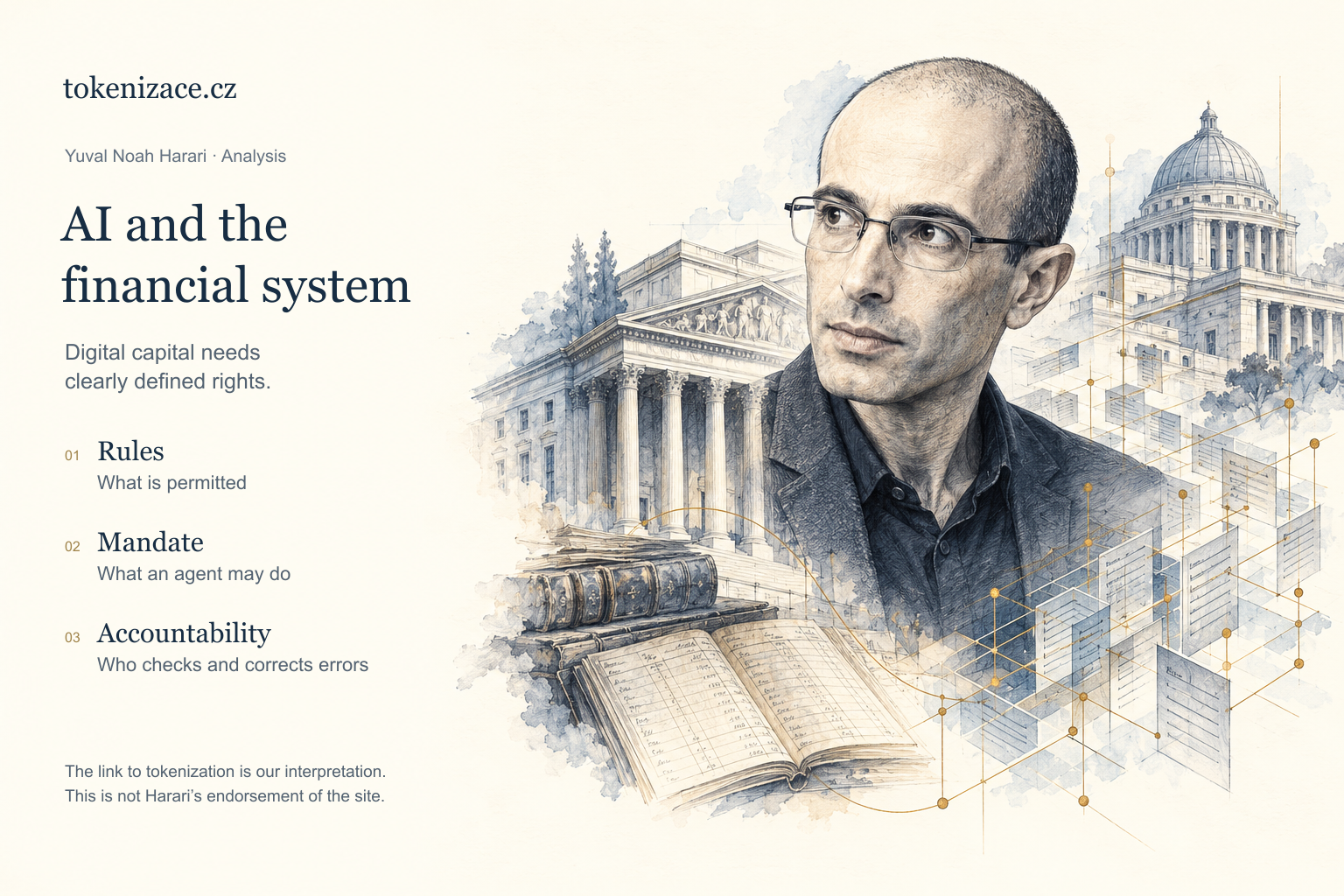
Infographic and audio overview
Listen to the audio overview · English
An AI-generated editorial audio overview by Tokenizace.cz. This is not Harari’s voice or a recording of the interview.
From rules to governed action
- 01RulesWhat is permitted
- 02RightsWho holds what
- 03MandateWhat an agent may do
- 04ExecutionControl and record
Key ideas
- AI in a decision-making process needs a clear mandate, verifiable evidence and accountability.
- A token can represent a legally grounded claim; it does not replace legal assessment or a licence.
- A company’s first pilot should test a specific benefit and an error-handling procedure, alongside the speed of automation.
Basis of this article
Harari’s interview on Czech Television, Oxford lecture and IMF interview, alongside documents from BIS, FSB, ESMA, the European Commission and NIST. The connection with tokenization is our own editorial interpretation.
Harari’s statement and our analysis
“AI will start taking over the financial system” is our translation of the Czech ČT24 headline accompanying the interview with Yuval Noah Harari on Hyde Park Civilizace. Czech Television introduces him as a historian and one of the world’s most influential intellectuals. Interview on Czech Television.
The analysis below connects this warning with Harari’s other public appearances and documents from financial institutions. The discussion of how tokenization might help define rights and AI agents’ mandates is our editorial interpretation, not Harari’s proposal or a promise of a particular outcome.
Bureaucracy determines access
A loan application, a transfer of ownership and the release of a payment share a problem: someone must determine whether the conditions have been met. This unobtrusive layer helps decide who gains access to capital. When a business introduces AI into it, speed should sit alongside questions about the origin of the evidence, the possibility of challenging a decision and the person accountable for the outcome.
We can illustrate the purpose of these systems with two businesses whose owners have never met. Shared rules let them agree what delivery, acceptance and payment mean. Registers help establish whom they are dealing with and who may represent the company; accounts record obligations as they arise and are settled. Cooperation need not therefore begin with personal trust or a fresh negotiation of every condition. Trust can rest on a shared procedure and verifiable records, provided they are reliable and there is a way to correct errors.
In his English-language Tanner Lecture at Oxford in 2026, Harari connects large-scale human cooperation with bureaucratic systems of trust. He warns that AI could take over important decision-making processes, including lending decisions. Lecture on Harari’s official channel.
In a December 2024 interview with the IMF, he describes a scenario in which AI creates financial instruments beyond human understanding and regulatory capacity. This is a warning about a possible development, not proof of inevitable AI rule. IMF Finance & Development interview.
Financial risk extends beyond a wrong answer
In 2024, the FSB highlighted financial institutions’ dependence on a small number of AI providers, correlated market responses, and model and data risks, among other concerns. FSB assessment.
We draw a practical implication for business leaders: checking whether a single answer looks reasonable is insufficient. They need to know which other processes rely on the same supplier or erroneous data. If a mistake feeds into approval, a contract and a payment, speed can multiply the damage before anyone notices.
What tokenisation can contribute
The BIS describes tokenisation as the digital representation of claims on a programmable platform. Its 2023 blueprint examines a shared environment for money and assets that could reduce separate settlement steps. BIS blueprint for the monetary system.
What matters here is the possibility of linking a specific claim to the rules governing its use. A token can represent a right where an appropriate legal basis exists. A technical record alone does not prove ownership of a building, the existence of a receivable or a debtor’s ability to pay. This is also distinct from a token meaning a unit of text processed by a language model.
This, in our view, is where digital capital connects with AI. To work on financing, an agent needs more than a company description: it needs machine-readable rights, current data and a precise mandate specifying who holds a claim, what it permits, what supports it and which steps the agent may perform. Such an arrangement could let it compare evidence and prepare proposals within defined rules. Tokenisation can be one layer that records these rights and their transfers; depending on the case, another kind of register can serve a similar purpose. It is neither the only route nor a guarantee of a correct outcome.
Programmable rules need governance
The authors of the BIS Bulletin on tokenisation distinguish asset and ownership information from the platform’s rules and governance. The tokenisation continuum. The FSB also warns that tokenisation can introduce operational vulnerabilities and complex links between participants. FSB report on tokenisation.
A record can be technically accurate while resting on false evidence. We therefore need to establish who verifies inputs, corrects errors and resolves disputes. Automatically executing a predefined condition is not the same as making a sound decision. An immutable history does not, by itself, explain what happens if a court rules otherwise or an authorised person loses access.
A right, a licence and a token are different things
MiCA excludes crypto-assets that qualify as financial instruments from its scope. MiCA, Article 2(4). ESMA emphasises that technological form should not determine classification and that tokenised financial instruments remain financial instruments. ESMA guidelines, general principle.
A business must therefore resolve separately what right it is offering, who may provide the associated service and how the operation will be executed technically. The existence of regulation is not a licence granted to a business; creating a token is neither. Calling a product digital capital does not replace this work. A specific structure requires assessment against its actual rights and activities.
An agent’s mandate should be specific
Article 14 of the AI Act addresses effective human oversight of high-risk systems; it is not a universal rule for every AI use. AI Act: human oversight. The voluntary NIST framework organises risk work into governing, mapping, measuring and managing. NIST AI RMF Core.
Our practical proposal for a business is to begin with a narrow mandate. An agent might compare an invoice with a purchase order and prepare a payment proposal. This does not automatically grant permission to change the recipient or send money. The business sets limits, access to evidence, approvers and a way to stop the process. It retains the document version used, the decision and the accountable person; a chat response alone is insufficient.
Start with one verifiable case
A hypothetical manufacturing company could begin by describing a single receivable: who owes the money, for what performance, when payment is due and whether the claim can be transferred. Only then is it useful to consider its digital representation and the automation of selected steps. A pilot should measure time, corrections and costs, including controls. Better records alone guarantee neither cheaper finance nor investor interest.
This is how we read Harari’s warning in relation to tokenisation: the more decision-making we entrust to software, the more precisely we need to define its authority and its connection to the real world. This connection is the editorial interpretation of Tokenizace.cz. The article does not constitute Harari’s endorsement of tokenisation, our website or any particular product.
Sources and lecture
- Česká televize — Hyde Park Civilizace: Yuval Noah Harari (2026) ↗
- AI has hacked the code of human civilization | Yuval Noah Harari ↗
- Humankind’s Comparative Advantage — Bruce Edwards, IMF Finance & Development ↗
- FSB assesses the financial stability implications of artificial intelligence (14. 11. 2024) ↗
- BIS Annual Economic Report 2023, Chapter III: Blueprint for the future monetary system: improving the old, enabling the new ↗
- BIS Bulletin No 72: The tokenisation continuum (11. 4. 2023) ↗
- FSB: The Financial Stability Implications of Tokenisation (22. 10. 2024) ↗
- MiCA, Article 2: Scope — ESMA Interactive Single Rulebook ↗
- ESMA: Guidelines on the conditions and criteria for the qualification of crypto-assets as financial instruments (2025) ↗
- AI Act, Article 14: Human oversight — European Commission AI Act Service Desk ↗
- NIST AI Risk Management Framework 1.0: AI RMF Core ↗
Method: we use the listed primary sources and distinguish their findings from our own interpretation. The example company is illustrative. Sources reviewed as of 19 October 2026.
This article provides context, not investment or legal advice. Any specific structure requires individual assessment.