The Netherlands faces a legal boundary in tokenization. Which record actually creates a security?
AFM and DNB warn that Dutch law does not permit the direct issuance of securities existing solely as tokens. Hybrid models retain traditional records alongside the digital register; the European pilot regime does not replace national private law.
Take the full article to your ChatGPT, Claude or Gemini and explore what it means for your work.
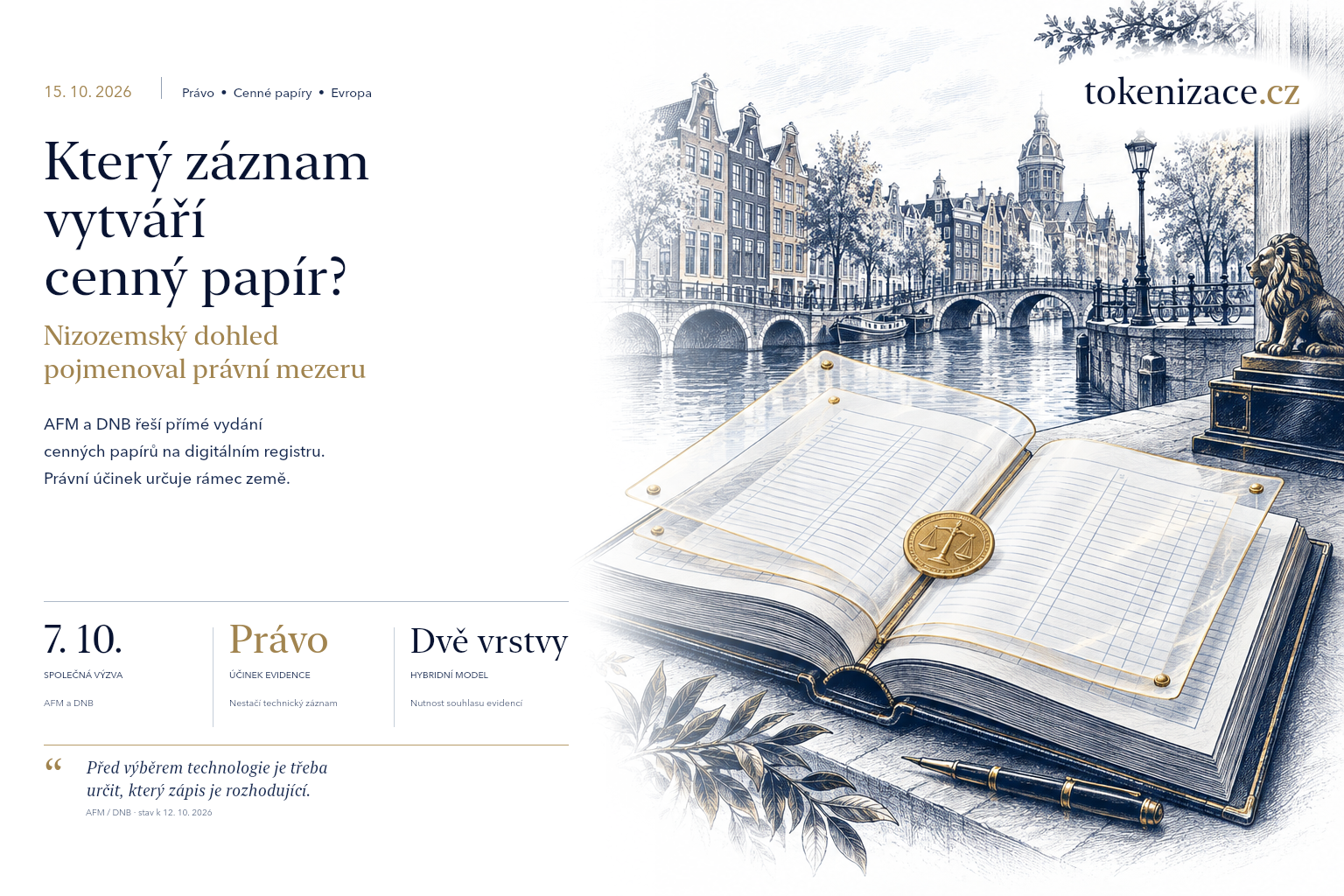
A digital register can work flawlessly while still failing to replace the legally authoritative record of ownership. Dutch regulators now explain how this gap limits the practical use of tokenized securities.
Summary for readers
- According to their study, AFM and DNB warn that Dutch law does not permit the direct issuance of securities existing solely as tokens.
- Hybrid models may retain traditional records alongside the digital register.
- The European pilot regime for DLT infrastructures does not itself replace national private law.
The problem does not begin with technological performance
The study examines the relationship between European rules and Dutch securities law. AFM and DNB recommend targeted modernization of the legal framework and work on specific use cases. They consider it important for the rules to allow the creation, holding and transfer of rights to be established reliably. This is not an announcement that a new law has been adopted. AFM/DNB study, pp. 3–4.
This is a different question from whether a database records a transaction quickly. A technical system can accurately record what participants have done within it. The legal effect of that action, however, depends on the instrument, the applicable legal system and the structure of the records. It cannot simply be inferred from a technical description.
Keeping two sets of records has its own operating cost
When a digital representation accompanies a traditionally recorded asset, both layers must remain consistent. The editorial question is who checks this consistency and what happens when they differ. For example, whether a transfer in one layer waits for confirmation from the other, and how the client learns that the process is not yet complete.
A hybrid structure may be a sensible way to introduce a new service. It is not, in itself, evidence of poor design. Its assessment must nevertheless include the work required to maintain the connection. If a new register is merely added without simplifying the original steps, the expected savings may not materialize.
Authorization, the instrument and the transfer raise different questions
An issuer benefits from separating what it issues, who may provide the related services and how ownership changes. A service provider's authorization does not, by itself, describe all the holder's rights. Nor does a token's technical standard determine the law under which an investor can enforce a claim.
The study highlights precisely this difference between the scope available for DLT infrastructure at European level and national rules governing the rights themselves. A practical assessment must connect both layers. Readers should understand that this is not a single box marked “regulated” that can be checked once to settle every other question.
Implications for Czech and Slovak businesses
The Dutch conclusion is not an opinion on issuance under Czech or Slovak law. It is, however, a useful starting point for commissioning an assessment of one's own. A company should require a precise description of the investor's claim, the legally decisive records, and the mechanism for transfer or creation of security interests. A dispute or the insolvency of a participating party needs separate consideration.
That assessment should follow a specific transaction flow. What does the customer sign? Who checks that the conditions have been met? How is it demonstrated that the holder actually acquired the relevant right? And what happens if the holder loses the means of access? These answers should not emerge only after the product has been sold.
A clearer legal foundation can simplify operations
The benefit of legislation is often described as removing barriers to innovation. A business is more interested in the concrete outcome: less uncertainty in the records, fewer discrepancies and clearer investor servicing. The Dutch call thus shows that sound tokenization requires the legal relationship and its digital processing to be designed together.
Sources
Methodological note
The article separates institutional announcements from the publication's own editorial analysis. Sources include both direct evidence concerning the event and thematic context; their inclusion does not mean they all describe the same transaction. Examples and questions for businesses are the author's interpretation, not findings about a particular client. A scheduled publication date does not advance the date on which the sources were verified.
Disclaimer
This text is for information and education. It does not constitute investment, legal, tax or accounting advice, or an offer of financial services. Any application requires an individual assessment. The institutions mentioned are neither partners nor guarantors of Tokenizace.cz.
What this means for you
AI puts the article in the context of your role, company and industry. Choose the one working document you need now.
Saved outputs and notes are private. Making your profile public does not share them with other users.
Loading account…
Context and outlook
Loading…
Open the full category →Comments
No comments yet. Be the first!
Recommended reading
Related reading based on this article’s topic and category.