India’s five-billion-rupee bond: what tokenisation changes at the depository
REC accepted five billion rupees in the Indian pilot with a coupon of 7,30 % per annum. The Demat 2.0 programme preserves the depository’s role and investors’ existing accounts, while the cash leg consists of the central bank’s wholesale digital rupee. Issuances have already taken place; integrated secondary trading and retail access belong to later phases. A fast subscription is therefore not evidence of a liquid market.
Take the full article to your ChatGPT, Claude or Gemini and explore what it means for your work.
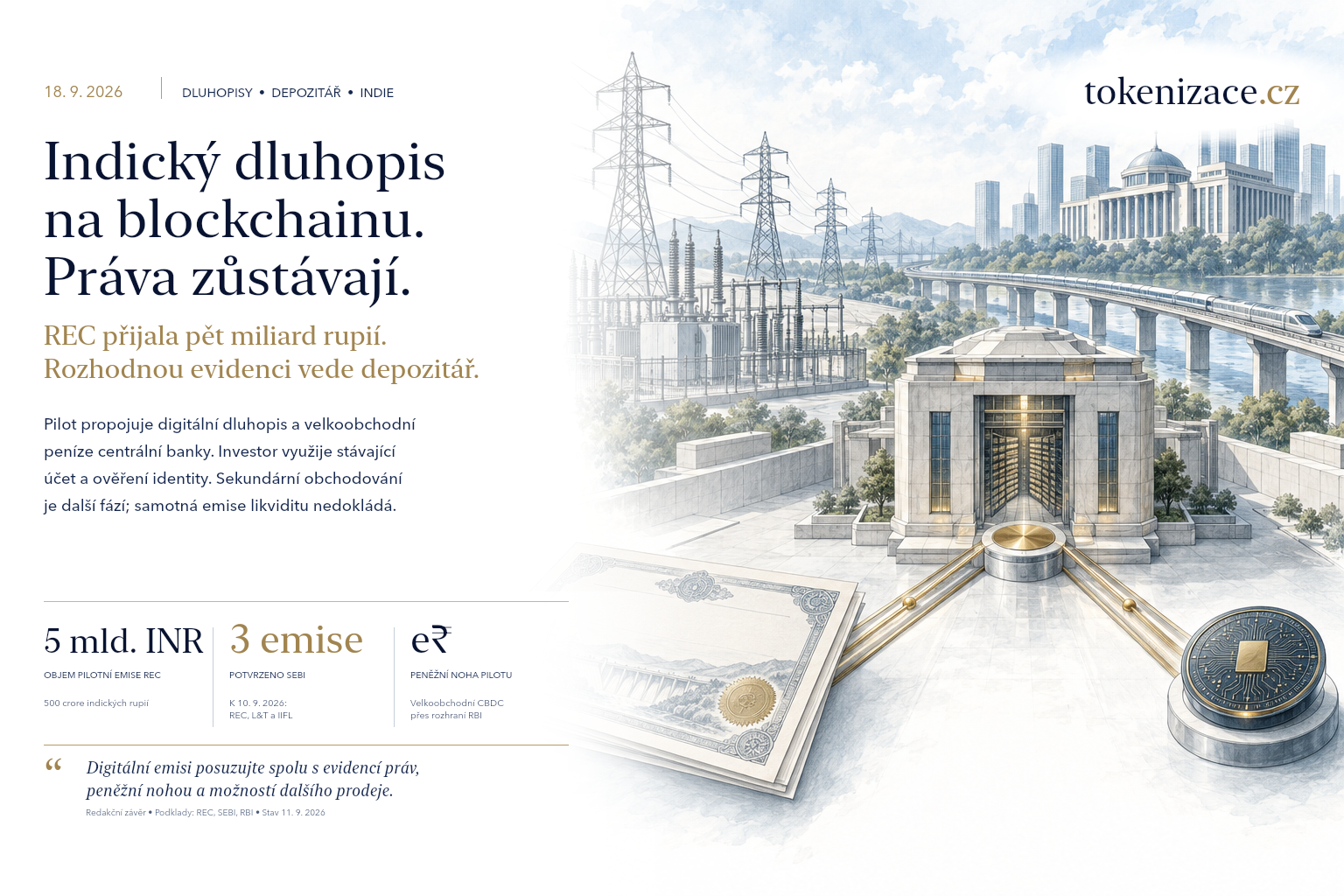
What is striking about Indian tokenisation is how few new things the investor has to manage. The familiar securities account remains, identification need not be repeated and the depository manages cryptographic keys. What changes is the infrastructure beneath the surface: the bond and central bank digital money are linked at settlement.
The case already has a real issuer and real financing. On 7 September, REC accepted five billion rupees in a pilot issuance. Three days later, SEBI described the entire Demat 2.0 programme and confirmed that two further issuances had been added. For a Czech business owner, the design question matters more than the transaction’s size: how to digitise a bond without dismantling familiar rights, responsibilities and investor access.
Summary for readers
- REC raised 500 crore INR, or five billion rupees, with a coupon of 7,30 % per annum. This is a corporate bond in a regulatory pilot.
- Demat 2.0 preserves the depository’s role and uses investors’ existing accounts. The cash leg consists of the central bank’s digital rupee.
- Issuances have already taken place; integrated secondary trading and retail access belong to later phases. A fast subscription is not yet evidence of a liquid market.
1. Five billion rupees and an important denominator
In its own announcement, REC states a base issuance of 100 crore rupees, an option to increase it by another 400 crore and an accepted amount of 500 crore. Demand reached 796 crore, the coupon is 7,30 % per annum and the tenor is one year and nine months. Bids were collected on NSE’s electronic platform; according to the issuer, receipt of funds, allotment and listing all occurred in one day.
The figure of almost eightfold demand relates to the base 100 crore. Relative to the accepted 500 crore, it corresponds to approximately 1,59 times. Both calculations can be correct, but they tell different stories. A company preparing its own issuance should always know the volume against which oversubscription is calculated.
Nor can the coupon establish how much tokenisation reduced the cost of financing. That would require a comparable conventional issuance by the same debtor, a similar maturity, valuation timing and the cost of the entire process. Investor interest may relate to creditworthiness and price as well as the new settlement method. The published figures do not separate these influences.
2. A new register within a familiar market
SEBI describes a private permissioned network owned by the depositories. They continue to maintain authoritative ownership records and manage investors’ keys. Demat 2.0 is an extension of the existing account, not a new account with new identity verification. The investor connects an eligible digital rupee wallet.
This structure has practical significance. If every technological change requires all participants to register again, acquire tools and change internal approvals, the advantage of faster transfers can disappear into implementation costs. Retaining the user interface limits the number of changes an investor must handle simultaneously.
Responsibility does not disappear. It merely moves into a system that must manage permissions, recovery, corrections and record checks. An investor need not care about the technology’s name; they need to know whom to notify of an error and which statement proves their holding. A clear answer may determine adoption more than technical novelty.
3. Money has its own legal nature
According to SEBI, Demat 2.0 connects to the wholesale digital rupee through the central bank’s Unified Market Interface. The intended settlement principle links delivery of the bond with payment: both legs succeed together.
The RBI explains the digital rupee as a digital form of its own currency. For this case, it is important to distinguish central bank money from a token issued by a private company. The same digital interface may conceal a different debtor and different conditions of use.
For corporate preparation, a simple procedure follows: first identify the asset and the money, then address their connection. Who delivers the bond, who provides payment, who recognises it as final and who handles failure? The operational team must be able to answer these questions during an outage too, not just on a diagram of a successful transaction.
In comparing stablecoins and tokenised deposits, the BIS emphasises the importance of settlement arrangements for the singleness of money. This analytical framework helps assess the monetary layer; it is not an evaluation of REC’s specific issuance.
4. Discovering a price and settling a trade are two jobs
The Indian model does not create the entire market from scratch. NSE has operated an electronic bidding platform for private bond issuances since 2016. Its purpose is to organise price formation and participant access. Tokenised settlement builds on this established part of the process.
This usefully corrects the idea that blockchain automatically finds buyers. The issuer still needs a suitable price, documentation and investors willing to bear the risk. Better records may reduce administrative friction, but do not answer whether the business will earn enough to repay.
When assessing the benefit, we would therefore track offering preparation time, subscription success, settlement time and subsequent administration costs separately. It is possible to improve one part substantially while gaining almost nothing in another. A blanket slogan about cheaper tokenisation conceals such differences. A well-run pilot, conversely, allows them to be measured and compared with baseline operations.
5. The largest gap still comes after issuance
SEBI describes the ongoing first issuance phase and later expansion to secondary trading and retail. The FAQ also permits an interim transfer through the depository in which payment may occur outside the atomic architecture. This is a fundamental boundary for anyone seeking to infer ready-made liquidity from the pilot.
Future integration will use existing RFQ platforms. NSE describes them as an environment in which a participant asks others for a price and subsequently accepts a specific trade. The mere presence of the tool therefore does not mean that every sale is automatically matched.
An investor considering an early exit needs to know the buyer, price, transfer method and when money will be received. “The bond is tokenised” addresses none of these conditions. For an issuer, it is important not to promise ongoing saleability if the infrastructure has so far demonstrated only subscription. Clearly defining the transitional period protects every participant’s trust.
6. An automatic coupon needs real money
SEBI’s press release envisages automating interest payments and redemption through instructions on a shared register. The aim is to reduce repeated exchanges of holder lists and calculation inputs between institutions.
From a management perspective, however, automation begins with correct instructions. The system needs a precise calendar, calculation rules, the record time for holdings and a funded wallet. If the issuer has no money, a programmed instruction does not create its ability to pay. If it contains an incorrect rate, it may execute that rate very consistently.
During internal verification, a company should therefore deliberately work through unpleasant situations too: a change of entitled recipient, a legal restriction, insufficient funds or a dispute over the payment amount. This is not a claim that REC has such problems. It is a proposal for controls that distinguish an attractive demonstration from debt administration throughout its term. A successful issuance day is only the beginning of this responsibility.
7. The pilot already extends beyond a single case
As of 10 September, SEBI confirmed issuances by L and T and IIFL on 9 September in addition to REC. Together, they amounted to 1 025 crore rupees. Repeating the process with several issuers is a more valuable signal than a single demonstration transaction, but still says nothing about long-term costs or liquidity.
We would consider a successfully handled interest payment, early transfer, accounting period close and recovery after an incident the next important evidence. Such observations would show whether shared records reduce everyone’s work or merely shift it between institutions.
Exceptions deserve particular attention. A system that is fast on average can be expensive if specialists handle every non-standard situation manually. The benefit should therefore be tracked not only for a normal trade, but also through the time needed to resolve a complaint and the number of interventions in records. We propose these indicators as editorial measures, not as published pilot results.
8. What Czech and Slovak companies can adopt
A European business cannot use the Indian sandbox as its own legal authorisation. Moreover, MiCA excludes crypto-assets that are financial instruments from its scope in the EU. A tokenised investment bond is therefore not assessed by the token’s marketing name.
The European DLT Pilot establishes a special regime for selected market infrastructures and specific exemptions. It is not general permission to issue any debt and trade it publicly.
What is transferable is the sequence of work: define the investor’s right, identify authoritative records, design cash settlement and arrange servicing. Only then does it make sense to decide which parts to connect technologically. A company can prepare a single end-to-end record from approval of the issuance through receipt of funds to final repayment.
The Indian case shows an ambitious change within established institutions. Its significance for the Czech market lies in the fact that a digital bond can remain operationally familiar to an investor. The result, however, will be determined by management of the issuance’s entire life, including when an investor wants to exit early or a debtor fails to pay on time.
Links and sources
Ledger Insights — REC issues first tokenized corporate bond, 8. 9. 2026
REC — pilot issuance announcement, 7. and 8. 9. 2026
SEBI — Demat 2.0, press release 56/2026, 10. 9. 2026
SEBI — Demat 2.0 FAQ
RBI — Digital Rupee FAQ
NSE — Electronic Debt Bidding Platform
NSE — Request for Quote FAQ
BIS — Stablecoins versus tokenised deposits, Bulletin 73
EUR-Lex — MiCA, Regulation (EU) 2023/1114, especially Article 2
EUR-Lex — DLT Pilot, Regulation (EU) 2022/858
Methodological note
The source cutoff is 11 September 2026; 18 September is the planned publication date. REC’s announcement and SEBI’s full PDF were downloaded and read directly. Issuance figures come from the regulator and issuer; the economic assessment and proposed control questions are our own editorial analysis. Later phases are not presented as launched. The claim to being first relates to the pilot described by SEBI, not all bonds worldwide.
Basis of the article: the author’s analysis draws on REC’s announcement, the press release and FAQ from Indian regulator SEBI, RBI documents and market infrastructure rules. The lead is a Ledger Insights report of 8 September. The article separates completed issuances from planned secondary trading and explains why technology alone creates neither better creditworthiness nor a guaranteed investment exit.
This article is for information and educational purposes. It is not investment, legal, tax or regulatory advice or an offer of securities. The legal classification, availability and risks of a specific instrument require separate assessment.
What this means for you
AI puts the article in the context of your role, company and industry. Choose the one working document you need now.
Saved outputs and notes are private. Making your profile public does not share them with other users.
Loading account…
Context and outlook
Loading…
Open the full category →Comments
No comments yet. Be the first!
Recommended reading
Related reading based on this article’s topic and category.