Hong Kong wants to make bank collateral usable outside business hours. It is preparing a tokenised bills test
Hong Kong plans to test tokenised Exchange Fund Bills and digital settlement in EnsembleTX by the end of 2026. The amount of more than HKD 1,3 trillion refers to existing instruments, rather than the value of tokens already created.
Take the full article to your ChatGPT, Claude or Gemini and explore what it means for your work.
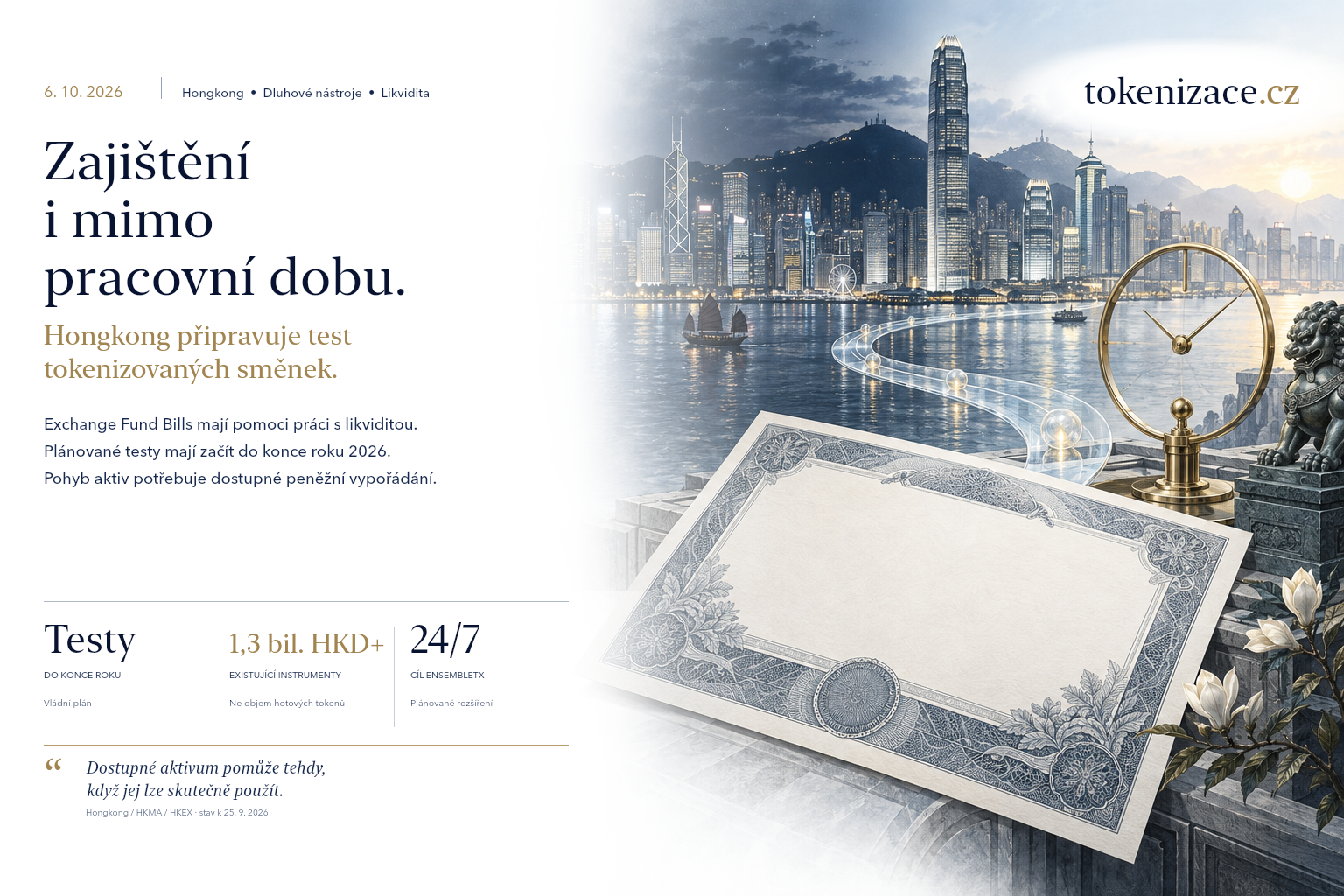
Financial markets can trade late into the night while cash and banking processes still follow a narrower business window. This mismatch creates a need to prepare liquidity in advance. Hong Kong wants to address part of it by tokenising Exchange Fund Bills, short-term debt instruments of its monetary fund, and expanding digital settlement.
The government's September programme envisages tests by the end of the year. The intention connects availability of the asset with availability of the money used to settle it. Their simultaneous availability will determine whether a bank can use high-quality collateral when it needs it, or merely see its digital record outside normal operating hours.
Summary for readers
- Hong Kong plans to test the operation of tokenised Exchange Fund Bills by the end of 2026; this is not completed tokenisation of the entire market.
- The stated figure of more than 1,3 trillion Hong Kong dollars refers to the amount of the relevant existing instruments, rather than the value of tokens already created.
- The parallel plan for digital settlement and round-the-clock operation of EnsembleTX shows that movable collateral also needs available monetary infrastructure.
What the government included in its programme
The programme of 16 September, point 35, envisages tests of tokenising Exchange Fund Bills by the end of the year. The aim is to let banks use these instruments more efficiently in asset and liability management outside normal hours as well. It mentions an existing amount of more than HKD 1,3 trillion. It also envisages more regular issuance of digital bonds and continued legal review of their use.
Another part of the same programme, point 50, states the intention to introduce settlement in digital central bank money within EnsembleTX and round-the-clock operation around the end of the year. These are planned steps. As of the verification date, programme statements cannot be turned into claims that all the functions described are already operating in full.
The large number in the announcement should be read carefully. It describes a potentially relevant asset base. It does not say how much will be included in the first trial, how many institutions will use it or what volume of transactions will actually occur.
Exchange Fund Bills are not ordinary corporate issuance
HKMA describes the Exchange Fund Bills and Notes programme as part of monetary management and bond-market development. It issues these instruments for the account of the Exchange Fund. They cannot be equated without explanation with any corporate bond or with all Hong Kong government debt instruments.
For tokenisation, their institutional role matters. They are not merely securities that someone holds to maturity. They may also be relevant to liquidity management and collateralisation of financial operations. Improving their technical usability can therefore affect other processes that depend on them.
A digital format does not, however, itself change maturity, yield or the legal claim. Before use in a specific system, it must be clear which instrument the digital record represents and on what terms a counterparty will accept it.
The cause of the problem is visible in an afternoon cut-off
In June, HKEX and HKMA announced a pilot for derivatives trading outside normal hours. In it, the exchange describes a specific operating constraint: under the arrangement described at that time, participants had to submit requests for advance margin deposits by 15h for the funds to count towards the subsequent evening trading session. The pilot examines using wholesale central bank digital currency for these payments.
The announcement also makes both actual trial transactions and wider implementation conditional on regulatory approval, market readiness and other circumstances. Here too, it is therefore incorrect to confuse an announced pilot with a service automatically available to everyone.
The example explains why operating hours merit attention. An institution may have sufficient high-quality assets but need to prepare them before it knows the actual needs of evening trading. A technical change is beneficial if it allows a later and more precise response without weakening risk controls.
Round-the-clock transfers require a round-the-clock ability to respond
EnsembleTX was introduced in November 2025 as the next phase of work with real transactions in tokenised deposits and digital assets. HKMA's materials for 2026 envisage gradual expansion of the environment. The September programme therefore builds on a longer preparation process.
However, access 24 hours a day is not simply a database feature. If an institution is to use an asset at night, it needs available approvals, correct valuation, knowledge of limits and a failure procedure. Not all steps need to be performed manually by a person. It must nevertheless be clear who bears responsibility and when an automated procedure stops.
In an illustrative situation, a bank may identify an additional collateral requirement during an evening market move. A faster transfer helps only if the recipient accepts the asset, cash settlement is available and no limit has been exceeded. This example is an analytical illustration, rather than a description of a disclosed transaction in the Hong Kong pilot.
Collateral has its own rules
HKEX publishes rules on acceptable collateral, including categories of instruments and the corresponding valuation haircuts. These are the terms that determine how much recognised value a particular asset can provide as collateral. A fast digital transfer does not remove this economic layer.
For a new solution, it will therefore be important to observe whether it changes only the location of the record or also the actual ability to use assets between institutions. Equally important will be the ability to return an asset, replace it with other collateral and resolve a discrepancy between technical state and contractual entitlement.
The number of tokens issued is a weak indicator for such an assessment. Documented operations will be stronger evidence: repeated movements, the number of counterparties involved, exceptions handled and an actual change in the need for prefunded liquidity.
What to watch from Czechia and Slovakia
Hong Kong's plan is not a product offer for Czech businesses. It is, however, a practical example of how tokenisation can focus on a specific timing obstacle in financial operations. For companies trading across time zones, availability of money and collateral is often more important than the technical speed of one transaction.
When assessing a banking service, it is therefore worth establishing the complete usable time frame: when an instruction can be submitted, when the system processes it, when settlement is complete and when the funds are actually available. Marketing a service as round-the-clock need not mean that every subsequent step has the same availability.
By the end of the year, publication of specific terms and test results will be a relevant signal. The September programme currently sets a direction. Its benefit will become clear only when a high-quality asset, cash settlement and operational responsibility can function at the same time.
Sources
Methodological note
The government timetable is presented as a plan, rather than an achieved state. The figure of HKD 1,3 trillion denotes the base of instruments mentioned in the programme, rather than a tokenised volume. The June HKEX pilot is a separate initiative. The illustrative evening process and assessment criteria are editorial interpretations. The sources were verified as of 25. 9. 2026, rather than the future publication date.
Disclaimer
This article is for information and education. It does not constitute legal, investment, tax or regulatory advice, or a recommendation of any particular product or provider.
What this means for you
AI puts the article in the context of your role, company and industry. Choose the one working document you need now.
Saved outputs and notes are private. Making your profile public does not share them with other users.
Loading account…
Context and outlook
Loading…
Open the full category →Comments
No comments yet. Be the first!
Recommended reading
Related reading based on this article’s topic and category.