Hong Kong issues more digital green bonds. The new feature is how investors pay
The HKMA has priced a fourth issuance of digital green bonds in four currencies, totalling the equivalent of around HKD 20 billion. The Hong Kong dollar tranche can be settled in the primary market using tokenised bank deposits supported by EnsembleTX.
Take the full article to your ChatGPT, Claude or Gemini and explore what it means for your work.
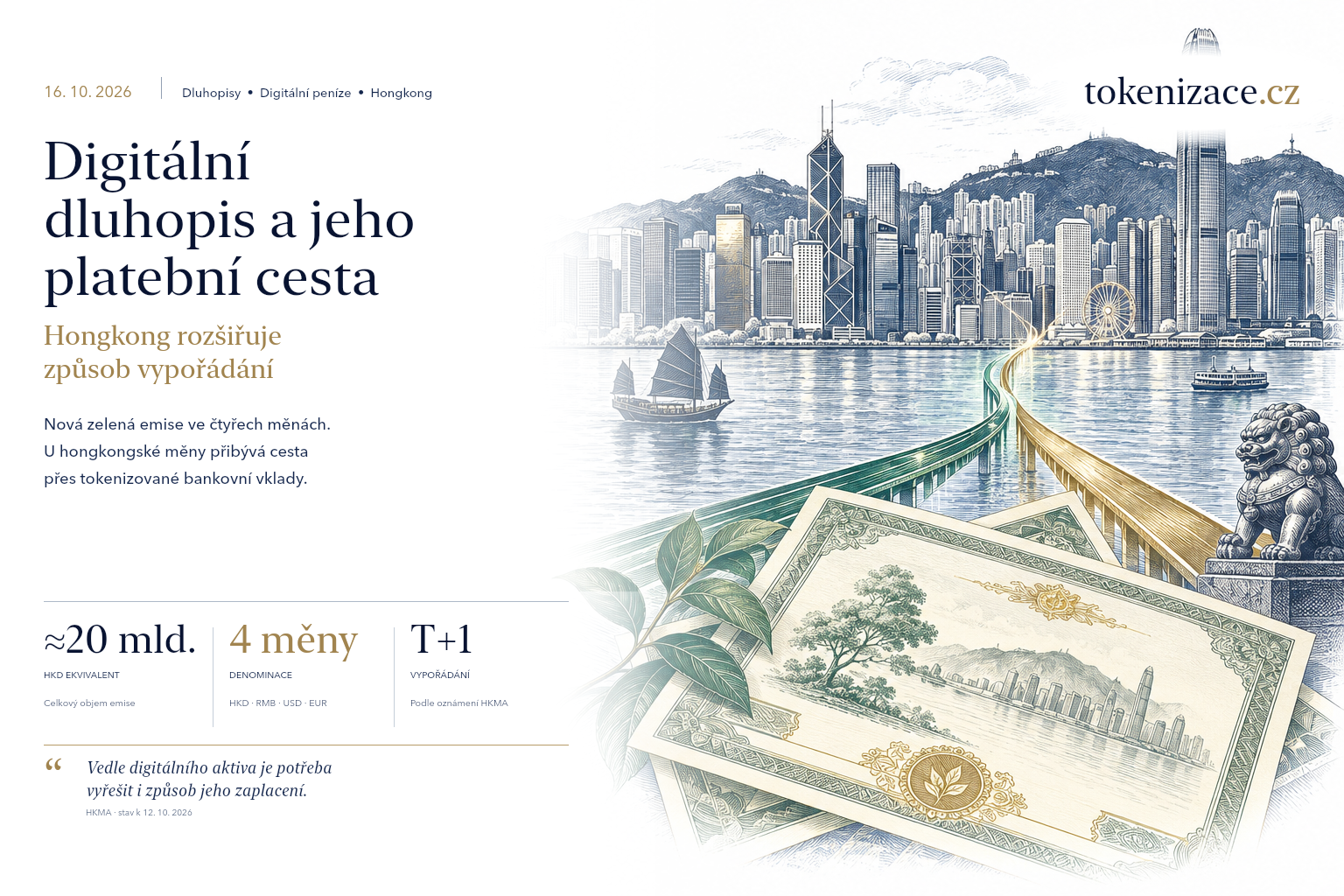
A bond can be digitised without changing how an investor pays for it. Hong Kong’s fourth issuance adds another option to this relationship: tokenised bank deposits denominated in Hong Kong dollars.
Summary for readers
- The HKMA announced the pricing of four currency tranches with an aggregate equivalent value of approximately HKD 20 billion.
- Tokenised deposits were incorporated into the primary settlement of the Hong Kong dollar tranche with support from EnsembleTX.
- Digital form, the means of payment and the green use of financing are three separate characteristics.
One issuance, several payment routes
According to the HKMA, the bonds were priced on 28 September in HKD, renminbi, US dollars and euros. The announcement identifies the CMU system and HSBC Orion platform. Alongside traditional settlement and the previously introduced option of tokenised central bank money, tokenised deposits are being added for the HKD tranche. The stated settlement cycle is T+1. HKMA.
This combination needs to be read carefully. The aggregate size of the issuance does not mean its entire volume passed through the new payment route. Nor does a description of digital infrastructure prove that all operations take place instantly. A more accurate picture emerges only when users know which parts of the transaction used each option.
A choice of settlement methods may broaden participation
From an editorial perspective, an important feature is that the new solution can be added alongside existing routes. Investors do not then have to change all their processes at once. The issuer can gain experience while preserving access for participants who still use traditional servicing arrangements.
This approach does, however, have its own cost. The operator must manage several routes, their interconnections and consistent records of the results. An evaluation would therefore benefit from tracking not only the speed of a single successful transaction, but also the number of exceptions and the effort needed to resolve them. The public announcement does not provide such a cost comparison.
A shared data language is a less conspicuous part of the change
The issuance uses Bond Data Taxonomy 2.0. ICMA introduced this standard as a machine-readable language for bond terms that can be used in both traditional and DLT processes. Its purpose is to harmonise the description of data, not to assess the quality of the issuer. ICMA.
For a general reader, a data standard may seem less impressive than digital money. For accounting and operations teams, however, it can matter. If every institution labels the same data item differently, converting and checking it creates work. Well-defined fields can reduce that work; filling them in correctly and managing them nevertheless remain specific responsibilities.
The green purpose requires separate verification
A project’s sustainability cannot be inferred from the way its bonds are recorded. Assessing it requires examining the framework for the use of issuance proceeds and the subsequent reporting. Digital records can help track data, but they do not in themselves confirm that the financed project has met an environmental objective.
The issuer’s ability to repay its obligation must likewise be assessed separately. The labels green and digital describe additional product characteristics; they are not a universal guarantee of return or safety.
Implications for Czech and Slovak companies
For a company considering bond financing, the transferable lesson concerns working with the investor: which payment route the investor can use and which information needs to enter its systems. This article does not imply that the Hong Kong structure can be adopted directly in another jurisdiction.
The initial project design should therefore bring together the intended investors, legal structure, payment options and data handling. Digitisation then gains commercial relevance. The question is not merely the form of the document issued, but whether the market can conveniently buy it, record it and service it throughout its life.
Sources
Methodological note
This article distinguishes institutional announcements from the editorial team’s own analysis. Sources include direct evidence for the event and thematic context; their inclusion does not mean that they all describe the same transaction. The examples and questions for companies are the author’s interpretation, not findings about a particular client. The scheduled publication date does not advance the date through which sources have been verified.
Disclaimer
This text is provided for information and education. It does not constitute investment, legal, tax or accounting advice, or an offer of a financial service. Any application requires an individual assessment. The institutions named are neither partners nor guarantors of Tokenizace.cz.
What this means for you
AI puts the article in the context of your role, company and industry. Choose the one working document you need now.
Saved outputs and notes are private. Making your profile public does not share them with other users.
Loading account…
Context and outlook
Loading…
Open the full category →Comments
No comments yet. Be the first!
Recommended reading
Related reading based on this article’s topic and category.