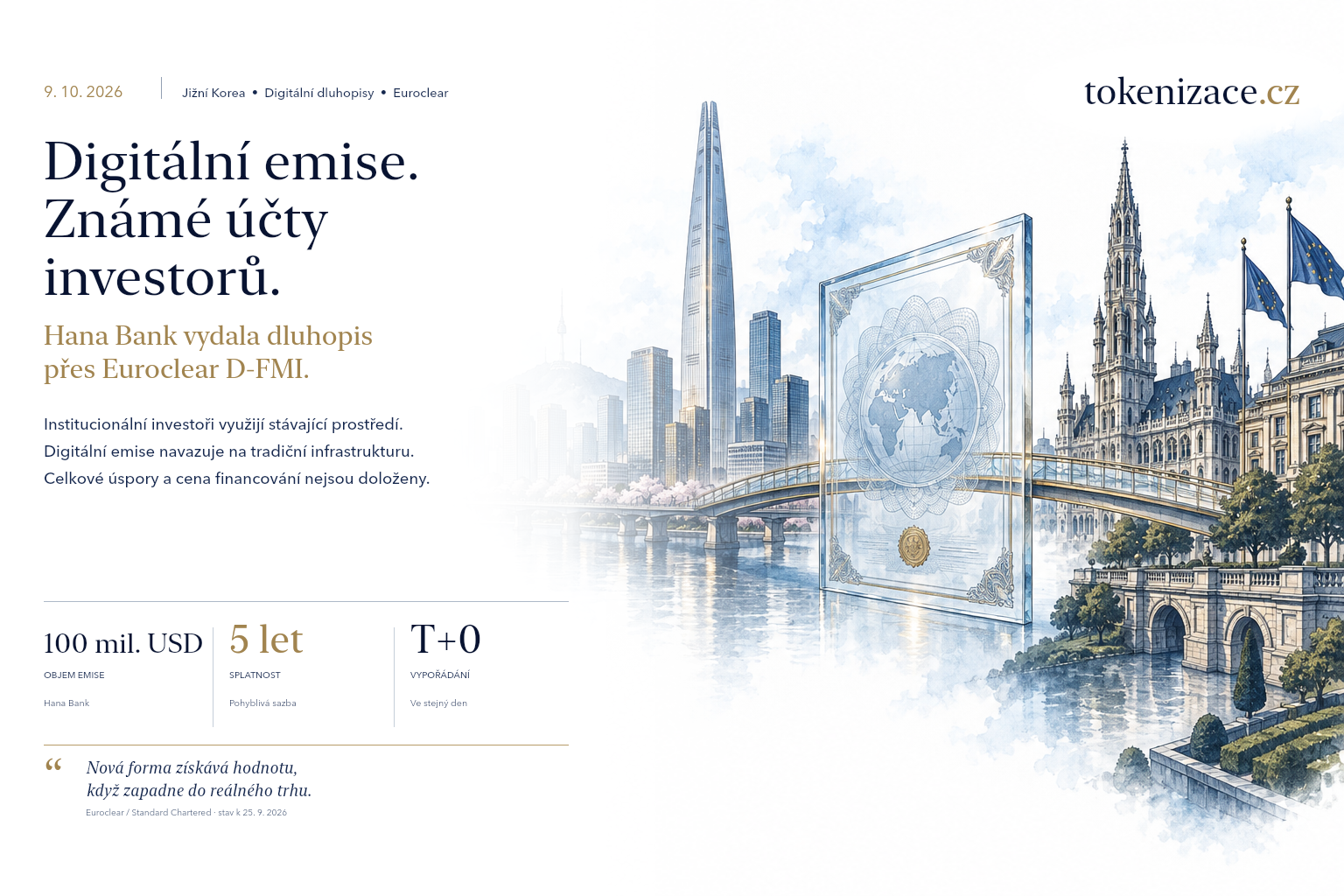
Hana Bank issued a 100 million dollar digital bond. Investors could keep using familiar accounts
Hana Bank issued a USD 100 million digital bond on Euroclear D-FMI, with a five-year maturity and T+0 settlement. Institutional investors could use the instrument through their existing accounts and systems.
Take the full article to your ChatGPT, Claude or Gemini and explore what it means for your work.
A digital issuance can be more complicated for an investor than a conventional bond if it requires new accounts, special operating procedures and separate administration. South Korea's Hana Bank illustrates another route: it used Euroclear's digital infrastructure, which connects to institutional investors' existing environment.
The 100 million dollar size and same-day settlement are visible features of the transaction. For the further adoption of similar issuances, it may be just as important that buyers do not have to leave established accounts and trading systems because of the digital format. The new record-keeping is thereby incorporated into a financing process that already has its participants, rules and operational support.
Summary for readers
- Hana Bank issued a USD 100 million digital bond on Euroclear D-FMI. It is the first Korean bank to issue through this platform, rather than the world's first digital bond.
- Standard Chartered confirms a five-year maturity, a floating rate, use of an existing issuance programme and T+0 settlement.
- Connection to conventional infrastructure allows institutional investors to use their existing accounts. This does not, on its own, demonstrate a lower interest rate, cheaper overall financing or active secondary trading.
What is actually documented about the transaction
In its announcement of 23 September, Euroclear confirms the issuance of a USD 100 million Digitally Native Note and states that Hana Bank is the first Korean bank to use its digital issuance platform in this way. According to the announcement, the bond was also the first digital bond admitted to SGX. Citi acted as issuing and paying agent.
Standard Chartered describes its role in structuring, leading and distributing the issuance. It adds the five-year maturity and floating rate. The transaction used Hana Bank's existing Global Medium Term Note programme and enabled same-day settlement.
This information documents a specific instrument that was issued. However, the press releases do not provide a complete cost breakdown or a comparison with an otherwise identical traditional issuance. The speed of the process therefore does not automatically allow savings to be calculated or establish that the bank obtained cheaper capital.
Investors did not have to start from scratch
Standard Chartered expressly states that institutional investors can transact in the digital instrument through their existing Euroclear accounts and systems. This is a practical feature that may influence willingness to adopt the new format. Every additional operational exception has to pass through the internal procedures of an asset manager, bank or other investor.
In an illustrative situation, an investment team may want the bond on economic grounds while the operations department has not yet established a way to hold and service it. The need for a new agreement, records, access permissions or accounting flow can delay the purchase. If the new instrument fits into a familiar environment, part of that obstacle becomes smaller.
This does not mean that no preparation is needed or that it is universally available to anyone. The acceptability of the instrument, internal limits and the relevant checks remain matters for the particular investor. What matters is that a digital format does not automatically have to mean a separate island with its own distribution network.
Two parts of the infrastructure serve different stages
The description of D-FMI distinguishes digital issuance from subsequent operations in Euroclear Bank's traditional system. The issuance service includes creating the instrument, assigning identification and delivery against payment. For secondary operations, it connects to the existing settlement platform.
An important boundary follows. Saying that an issuance used distributed records does not mean that every future transaction throughout the life cycle takes place in the same new environment. Connecting the two parts is itself part of the chosen model.
For an issuer, this may be a pragmatic approach. It introduces new technology where there is a specific process benefit while preserving connections to holding and trading arrangements familiar to investors. Success is then assessed by how well the whole arrangement works, rather than by how many existing systems were removed.
The platform's history allows comparison, not confusion between issuances
The World Bank issued the first digital instrument on this platform in October 2023. It was a three-year, 100 million euro issuance. This historical example has a different issuer, currency and maturity from Hana Bank's current transaction.
The World Bank case study helps explain the rationale for connecting the digital creation of an instrument to established market infrastructure. At the time, Euroclear described the launch of D-SI as the first step in a broader D-FMI strategy.
Hana Bank's present significance therefore lies in expanding the range of issuers and geographical use. Repeating the format alone does not establish how much of the bank's financing the digital route represents or how quickly it will become standard practice. That conclusion would require a longer series of comparable transactions.
Faster settlement changes how the day is organised
T+0 denotes same-day settlement. For the issuer, it matters when it can actually count on the proceeds of the issuance. For the investor, it is equally important when it must provide the money and have all checks completed. Shortening the time therefore shifts demands onto preparation, approvals and coordination between participants.
An illustrative chief financial officer cannot conclude from a faster technical transfer that preparing the issuance terms or discussions with investors can be postponed. If prior approvals are missing, the speed of record-keeping alone will not close the gap. The procedure for an incorrect instruction, insufficient funds or the failure of a participant also needs to be known.
The press release confirms the capability of a specific issuance process. It does not demonstrate a change to the settlement cycle of all bonds in the market or general uninterrupted operation without limitations. The precise operating hours and rules remain part of the terms of the relevant services.
A digital bond needs servicing after its issue date too
Euroclear describes its range of services across the securities life cycle. Beyond initial settlement, payments, records, information for holders and other events remain relevant. Citi's role in the World Bank's historical issuance shows that specialist agents still have a place in a digital arrangement.
For a corporate issuance, it is therefore appropriate to assess full costs and responsibilities from preparation through repayment. Comparing only the cost of creating a token would omit services that the holder needs for several years. With a floating rate, it is also important to process the relevant parameters correctly under the issuance terms; without the full documentation, this article does not elaborate on Hana Bank's specific mechanism.
What the case means for Czech and Slovak issuers
Hana Bank's case is not direct guidance that the same route will be economically suitable for a smaller Czech company. An institutional bank has different financing, distribution relationships and operational resources. The more transferable question is whether a proposed digital issuance will preserve access for the intended investors.
When comparing offers, an issuer should want to know who can actually buy the instrument, where they will hold it, how they will receive payments and on what terms they can transfer it. Alongside this, the issuer needs the full price, accountable counterparties and a realistic plan for servicing after issuance.
Hana Bank documents one completed route: the digital creation of a bond connected to existing accounts and market processes. The commercial value of such a change will become clear in whether it facilitates financing while preserving rights and reliable servicing. The mere presence of new technology does not guarantee that outcome.
Sources
Methodological note
The verification date is 25. 9. 2026. The decisive parameters of the current issuance come from Euroclear and Standard Chartered. The date of 23 September denotes their announcements; it is not, without further evidence, presented as the issue date itself. The earlier World Bank transactions serve only as labelled historical context. The illustrative operational implications are the author's interpretation. Without the full issuance terms and cost data, no savings, return or financing price is quantified.
Disclaimer
The article is for information and education. It is neither an offer of securities nor investment or legal advice. The suitability of a particular issuance depends on its terms, the issuer and the investor's situation.
What this means for you
AI puts the article in the context of your role, company and industry. Choose the one working document you need now.
Saved outputs and notes are private. Making your profile public does not share them with other users.
Loading account…
Context and outlook
Loading…
Open the full category →Comments
No comments yet. Be the first!
Recommended reading
Related reading based on this article’s topic and category.