British banks test tokenised deposits on mortgages. Money can wait without ceasing to work
The GBTD initiative announced its first live transactions: mortgage refinancing and a conditional payment. Reserved funds can continue to earn interest until the transaction is completed.
Take the full article to your ChatGPT, Claude or Gemini and explore what it means for your work.
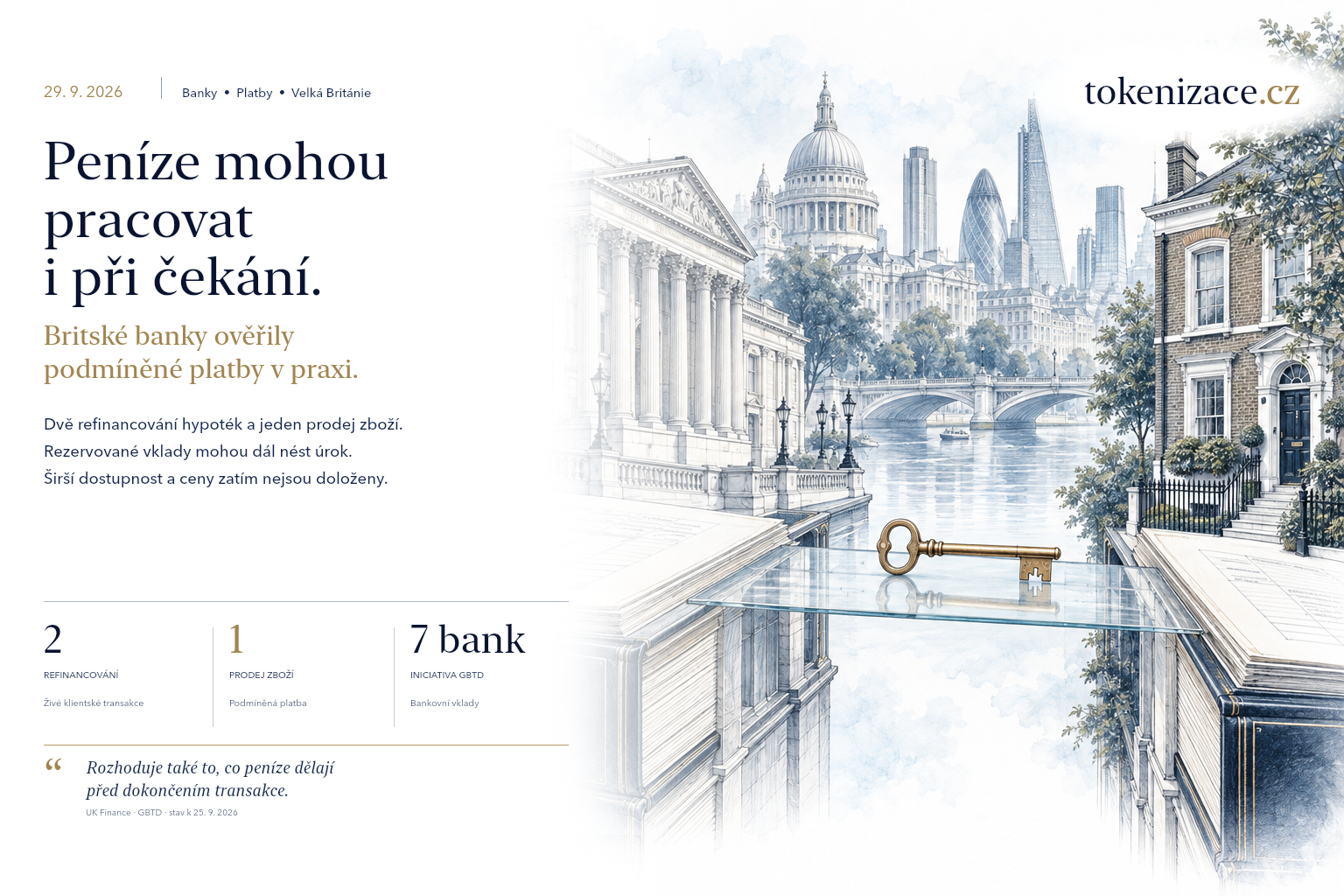
Completing a property transaction requires more than sending money quickly. It must leave precisely when the agreed conditions have been met, and until then it must be clear who owns it and who may use it. British banks have now moved this question from presentations to the first real customer transactions using tokenised deposits.
An unobtrusive detail deserves attention: under the model described, reserved funds can continue to earn interest until completion. The value of new payment infrastructure may therefore emerge in more than a shorter transfer. It can change the economics of waiting between the commitment to pay and actual settlement.
Summary for readers
- The GBTD initiative announced its first live customer transactions: two mortgage refinancings and one conditional payment in a private sale of goods.
- These are bank deposits with new technical capabilities. Tokenisation alone does not turn them into central bank money or a separate stablecoin.
- The experience is interesting for transactions in which money is reserved before conditions are met. The examples cited do not yet establish wider availability, pricing or measured savings.
What actually happened
In its September update, UK Finance describes two mortgage refinancing cases. Money was locked for a specific purpose and automatically released at completion. The third transaction linked payment to the handover of goods between private individuals. Quant provides the platform; the initiative includes Barclays, HSBC UK, Lloyds Banking Group, Monzo, Nationwide, NatWest and Santander.
The published description allows for funds to continue earning interest until completion. However, it gives no rates, transaction volumes or generally available customer pricing. Future integration with HM Land Registry’s digital processes is a direction for further development, not a demonstrated part of the cases already completed. Scenarios involving digital bonds and their cash flows are likewise yet to be expanded.
The distinction between an individual live case and an established service is substantial. The first case verifies that an agreed process can run from beginning to end. Routine operations can only be discussed once it can handle different customers, exceptions, cancelled transactions and predictable pricing.
Interest while waiting changes the project brief
Imagine a company due to pay for the transfer of business premises in a week. The seller wants certainty that the buyer has genuinely set the money aside. At the same time, the buyer does not want to send the amount before the transfer is ready. This is a hypothetical example, not another transaction announced by British banks.
A technical reservation mechanism can combine both needs. The funds can no longer be used for another purpose, but their banking and contractual treatment need not be identical to that of an early final payment. If the particular product permits interest to accrue, the economic difference grows with the amount and the waiting period. Without knowing the rate, service price and locking conditions, however, savings cannot honestly be quantified.
The chief financial officer’s first question should therefore be: for how many days, and how much money, do we currently hold outside normal use in order to coordinate transactions? Only then does it make sense to compare alternative technical solutions. For a small payment, the additional integration may outweigh the benefit. For repeated large advance payments, the outcome may be different.
A deposit needs a bank even in digital form
The joint British regulatory roadmap from 2023 distinguishes bank deposits, money issued by electronic money institutions and stablecoins. For banking innovations aimed at retail customers, it stresses the deposit form and the protection associated with the relevant regime. Digital units therefore cannot all be judged solely by the fact that they are recorded using similar technology.
In its December 2024 report on tokenised deposits, the European Banking Authority examines precisely this combination of potential benefits and regulatory and operational challenges. For a company, this leads to a practical check: against which institution does it hold a claim, how is that claim created and extinguished, and under what conditions can it be transferred or withdrawn? The label in an application does not replace this answer.
Any deposit insurance is also not an unlimited guarantee for every amount and every customer. A user must assess the specific product, institution, depositor eligibility and applicable limits. The British pilot itself provides no legal opinion on a Czech or Slovak product.
Two banks must align more than a message
The sender and recipient may hold accounts at different banks. Alongside the customer instruction, there is then also a relationship between those banks: who owes whom, when the obligation becomes final and which asset settles it. In its vision for the future monetary system, the BIS links tokenised bank money to the role of central bank reserves. A new user interface does not remove this institutional layer.
The Bank of England Synchronisation Lab examines the coordination of cash settlement with asset movements in other systems. The lab uses a simulation of selected RT2 capabilities; participation therefore does not prove that a particular commercial product already uses a fully deployed central bank synchronisation service. UK Finance states that the GBTD project participates in this programme.
For a manager, it is useful to distinguish three layers: the customer agreement, the reservation of funds and interbank settlement. Only their alignment produces a comprehensible transaction. The successful transmission of a technical message need not yet mean the final discharge of all related obligations.
What a Czech or Slovak business would measure
A first corporate pilot should start from a specific recurring process: for example, returning advance payments, transfers in an asset transaction or the phased release of payment for a delivery. We recommend recording in advance the reservation period, funding cost, number of manual checks and share of transactions handled outside the standard procedure. This is an editorial proposal for measurement, not published GBTD results.
Agreement on who confirms that a condition has been met is equally important. If a system waits for data from another organisation, the quality of that data becomes part of the payment process. An error in confirming a delivery is not solved by a faster transfer of money. A change in banking records must be accompanied by responsibility for inputs and the ability to remedy an incorrect procedure.
The British example is valuable because it shows a specific customer moment. The next evidence will have to be economic: whether repeated use shortens waiting, reduces manual work and leaves participants with understandable rights at an acceptable price. For companies, this is a much more useful question than the number of tokens created during a demonstration.
Sources
Methodological note
The description of live transactions is based on UK Finance. The infrastructure provider’s materials are its own communications; they are not an independent measurement of returns. The general regulatory context is not a legal assessment of a specific product. The corporate example and proposed metrics are editorial interpretation. The status of sources was checked as of 25. 9. 2026, not the future publication date.
Disclaimer
This article is for information and educational purposes. It does not constitute legal, investment, tax or regulatory advice, nor a recommendation of any specific provider.
What this means for you
AI puts the article in the context of your role, company and industry. Choose the one working document you need now.
Saved outputs and notes are private. Making your profile public does not share them with other users.
Loading account…
Context and outlook
Loading…
Open the full category →Comments
No comments yet. Be the first!
Recommended reading
Related reading based on this article’s topic and category.