CFTC clarifies the handling of tokenised customer funds. Blockchain must stand up to inspection too
CFTC divisions have expanded their interpretation concerning tokenised permitted investments of customer funds and blockchain records. Collateral, investment of customers’ money and record-keeping are three distinct regulatory questions.
Take the full article to your ChatGPT, Claude or Gemini and explore what it means for your work.
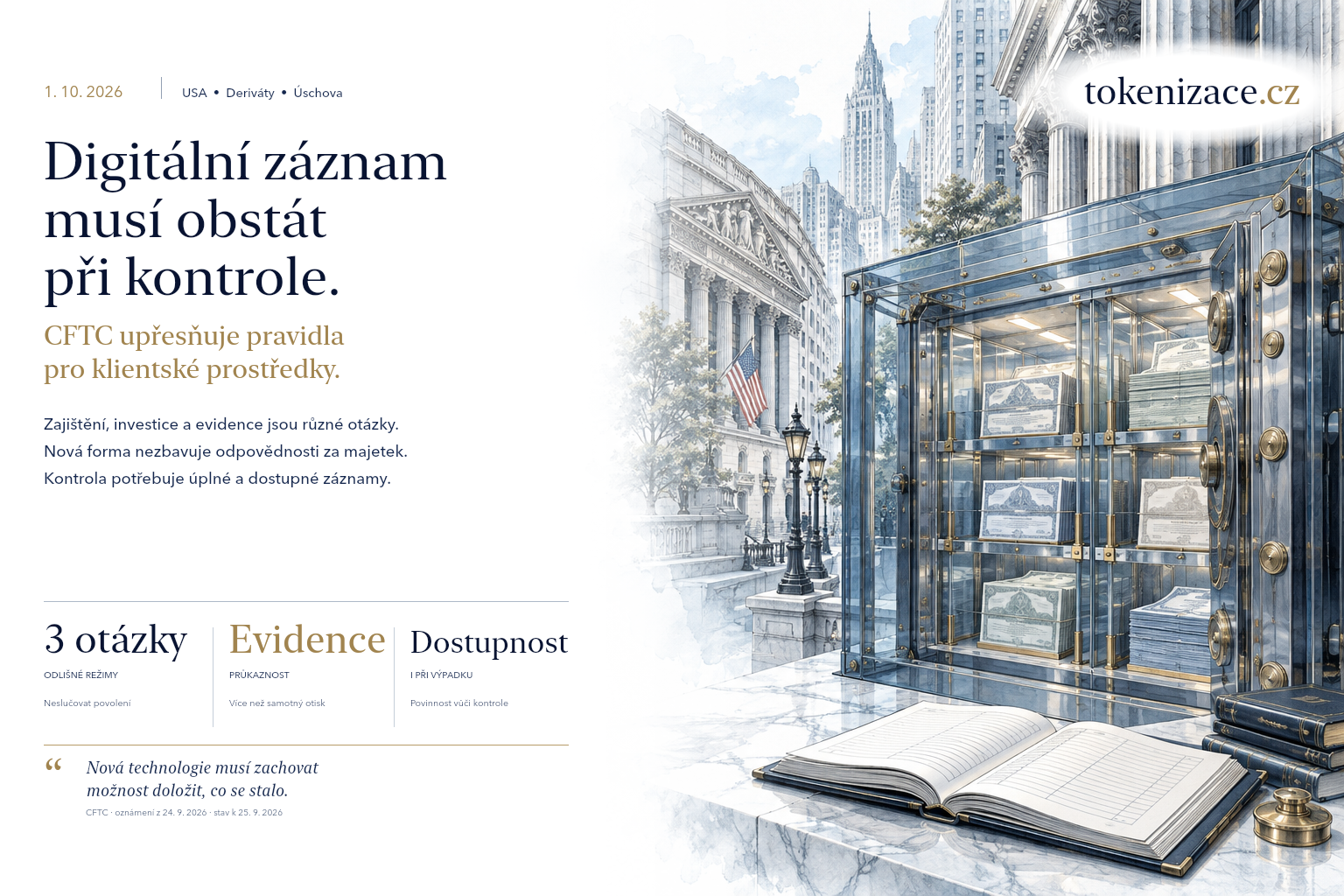
When a financial intermediary handles other people's funds, it cannot assess a technological innovation in the same way as an experiment with its own money. It needs to know which investments are permitted, who owns the assets and whether it can produce its records even when the system it uses fails. These are precisely the subjects addressed by a new clarification from the US CFTC.
The September update to frequently asked questions concerns tokenised forms of permitted investments of customer funds and the use of blockchain to maintain required records. For Czech and Slovak companies, it is useful as an illustration of how a regulated market separates a new technical format from continuing responsibility for customer assets.
Summary for readers
- On 24 September, CFTC divisions expanded their interpretation concerning investment of customer funds in tokenised forms of permitted instruments and blockchain record-keeping.
- Accepting an asset as collateral, investing customers' money and retaining records are three different regulatory questions. One positive answer does not automatically resolve the other two.
- The practical test of digital records is their completeness, evidential reliability and availability for inspection, including in an exceptional situation.
What the new update addresses
CFTC announcement 9303-26 identifies two areas of the expanded FAQs: tokenised forms of permitted investments of customer funds, and compliance with record-keeping obligations using blockchain technologies. It builds on the March FAQs and staff letters 25-39 and 26-05. It is not general permission to invest customers' money in any crypto-asset.
The letters and FAQs must also be read according to their legal status. Staff interpretations and a conditional no-action position are not the same as the Commission repealing rules in force. The relevant institution must still establish whether it meets the specific conditions applicable to its activities.
In this article, we do not expand the brief September announcement with details that do not directly follow from it. We describe the essential boundaries using the available letters, original FAQs and current wording of the rule on regulatory records.
Three questions that cannot be combined
The first question is what a customer may post as collateral. The second asks what an intermediary may invest funds entrusted by the client in. The third concerns how it reliably records receipt, holding and movement of those assets. Each has a different purpose and need not have the same answer.
The original March FAQs illustrate this using payment stablecoins. They expressly state that letter 26-05 does not change the list of permitted investments of customer funds under rule 1.25. The ability to deposit an intermediary's own funds into a segregated account under specified conditions is therefore not authorisation to buy the same instrument with a customer's money.
For a company using derivatives, for example to manage price or currency risk, this distinction has a very specific significance. Knowing that a provider supports digital collateral does not yet tell it what happens to customer cash or what claims a customer has if the provider fails.
A tokenised instrument must preserve clear legal relationships
CFTC letter 25-39 addresses tokenised collateral and reiterates, among other things, enforceability of the legal framework, the relationship to the underlying asset, custody and operational risks. A digital format does not exclude traditional questions about liquidity, valuation or the ability to actually dispose of the asset.
Consider an illustrative tokenised form of a short-term government instrument. It is necessary to establish whether the client or intermediary directly holds that security, a share in a fund or another claim against an intermediary. Three technically similar records can mean three different legal positions. This example is not an assessment of a particular product.
Letter 26-05 also describes the importance of separating customer funds from a firm's own funds. An accounting or application label saying “customer” does not itself create protection, however. The required rules must be reflected in actual account management, relationships with depositories and permitted dealings in the assets.
A blockchain entry is not the entire record
US rule 1.31 requires the authenticity and reliability of records. For electronic records, this also includes the data needed to access, search and display them, and information about their creation and modification. Institutions must ensure production of records and their availability during an emergency or system disruption. An inspecting authority may require a reasonable format and medium.
This is a more demanding requirement than showing that an immutable fingerprint exists somewhere. A fingerprint alone does not enable an inspector to read a contract, identify a client or reconstruct the correction of a wrongly allocated transaction. Technical integrity of one item and completeness of the body of evidence are different characteristics.
A practical test should therefore start with a specific question: can the responsible employee produce a complete and understandable account of a selected operation without help from the original developer? If they must first establish which application holds the contract and who can open the relevant format, the organisation still has a record-keeping problem, even if the transfer itself was flawless.
Who will bear the cost of an exceptional situation
In an ordinary demonstration, the connection works, the user has access and every system responds. Real asset management must also include provider downtime, incorrect data or changes in responsible personnel. Blockchain can make part of the process clearer, but it will not write operating rules on an institution's behalf.
The publication therefore recommends examining access recovery, export capability, connections to client records and procedures for discrepancies between systems. It is appropriate to determine in advance who may correct inaccurate information, who approves the correction and how its history is preserved. These are proposals for checks, rather than claims about the conduct of a particular US provider.
The economics of operations are equally important. If an institution maintains digital and traditional records in parallel, it must know which is authoritative in each situation and how much work their regular reconciliation requires. Expected savings should also account for controls, support and exceptional cases.
Benefits for Czech and Slovak companies
The US interpretation does not establish European authorisation to provide an investment or payment service. The approach to asking questions is transferable, however. A company should separately verify the legal nature of the instrument, how customer assets are held and the evidence for every operation.
When choosing a service, it helps to request a specific demonstration of both a normal process and one involving errors. What does a trade confirmation look like? How is ownership documented? What does the client receive when the relationship ends? How is a discrepancy corrected? The answers should also be understandable to people outside the technology team.
The CFTC's September step illustrates the continuing incorporation of digital formats into existing financial processes. Its value cannot be measured solely by the number of newly supported tokens. More important is whether they can be handled while preserving protection of customer funds and records that remain reliable under adverse conditions.
Sources
Methodological note
The September CFTC press release documents the current event. We expressly identify the March FAQs as the original document, rather than the complete text of the September update. Detailed operational conclusions draw on the identified letters and rule 1.31. The questions for checks are editorial interpretations. The sources were verified as of 25. 9. 2026, rather than the future publication date.
Disclaimer
This article is for information and education. It does not constitute legal, investment, tax or regulatory advice, or a recommendation of any particular instrument or provider.
What this means for you
AI puts the article in the context of your role, company and industry. Choose the one working document you need now.
Saved outputs and notes are private. Making your profile public does not share them with other users.
Loading account…
Context and outlook
Loading…
Open the full category →Comments
No comments yet. Be the first!
Recommended reading
Related reading based on this article’s topic and category.