Archax builds a US distribution route. A token alone will not open the market
Archax Markets has completed US broker-dealer registration and expects to begin operations in the third quarter of 2026. Distribution is to be complemented by tZERO services: settlement, custody, escrow and access to an alternative trading system. Registration of the intermediary does not approve an issuance or create liquidity. A US investor must be eligible for the specific offering, and European authorisation does not replace that requirement.
Take the full article to your ChatGPT, Claude or Gemini and explore what it means for your work.
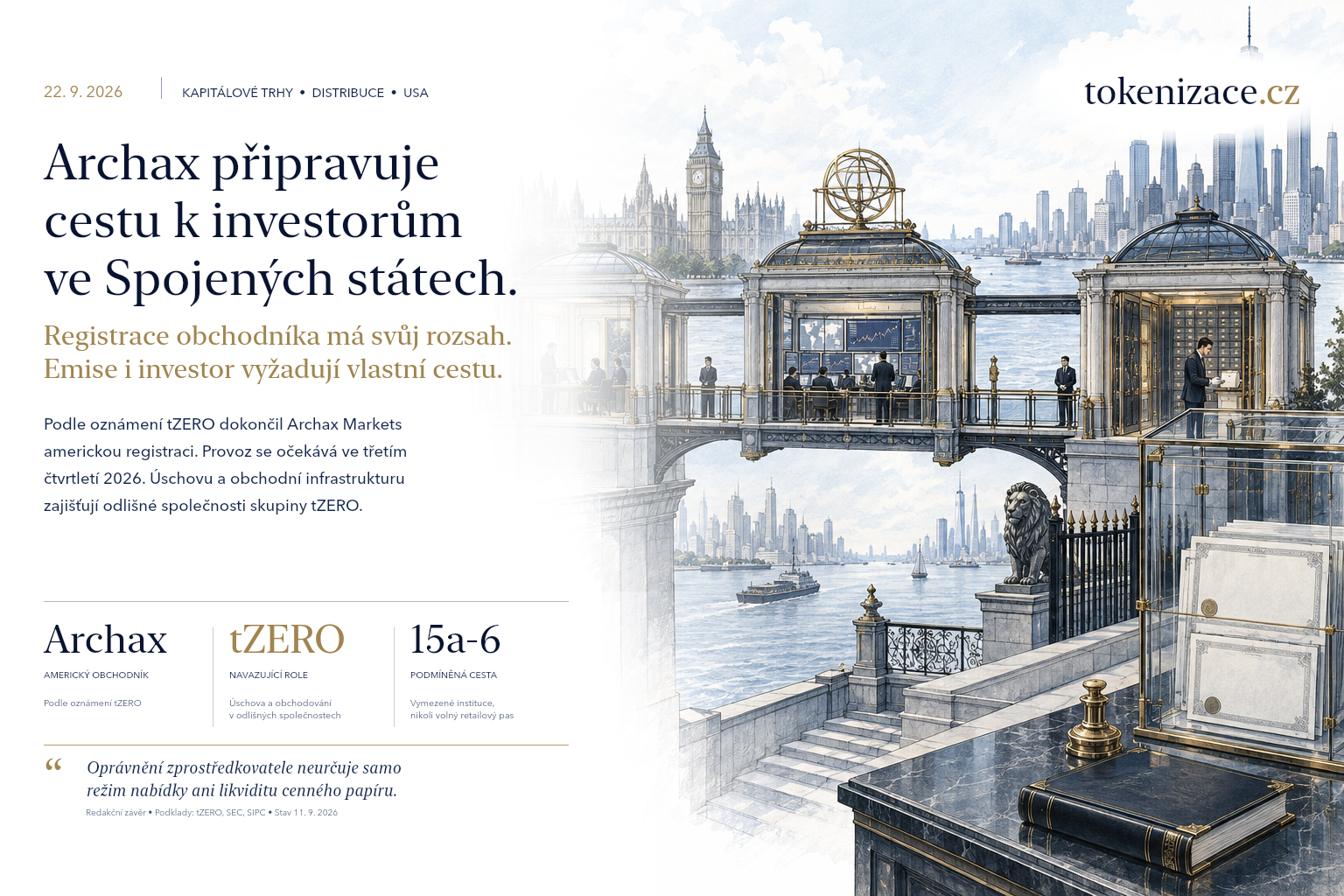
A European issuer can create a token, prepare documentation and find an interested American investor. Yet specific distribution, contractual and record-keeping obligations stand between interest and an actual investment. Archax and tZERO show how this route is assembled from several regulated roles. For Czech and Slovak companies, what matters is what such a combination allows them to procure as a service and what they must prepare themselves.
Summary for readers
- Archax announced completion of its US broker-dealer registration; it expects to begin operations in the third quarter. The announcement itself does not establish completed issuances or trades.
- Distribution is to be complemented by tZERO companies’ services: settlement, custody, escrow and access to an alternative trading system. Each role has its own scope of responsibility.
- A US investor must be eligible for the specific offering. Neither token availability nor a European authorisation replaces this condition.
1. What actually changed in September
According to tZERO’s announcement, Archax Markets LLC obtained approval of its new membership application from FINRA and completed broker-dealer registration with the SEC. It plans to begin US services in the third quarter of 2026. The release describes private offerings of traditional and digital securities to US institutional and accredited investors, and cooperation with selected foreign brokers.
The launch date must be read precisely. As of the editorial cutoff, we have an announcement of a prepared structure and expected operations, not public statistics on transactions actually completed. Ledger Insights places the event in the effort to connect European tokenised securities with American demand. That is a commercial ambition whose outcome will only be demonstrated by specific offerings.
For an issuer, this creates an opportunity to discuss a more comprehensive distribution service. The first commercial meeting should therefore begin with the issuance’s characteristics, investor group and expected financing volume. Only then does it make sense to determine which part of preparation the intermediary will handle, which its partner will handle and which the company must arrange separately. A precise service offering will be more valuable than a general promise of access to the United States.
2. Several responsible companies stand behind one interface
Archax is to act as an introducing broker: an intermediary establishing the customer relationship and passing on subsequent activities. The announced cooperation involves tZERO Securities LLC and tZERO Digital Asset Securities LLC. It covers correspondent settlement, digital securities custody, escrow and secondary trading through the ATS operated by tZERO Securities. This is not a set of authorisations automatically attributable to Archax itself.
Such an allocation requires a clear map of contracts. The issuer needs to know with whom it contracts for distribution, who receives money, who holds customer assets and who handles complaints. The investor, in turn, needs to know which company holds their account and from whom they receive statements. A common brand or convenient login may visually conceal these boundaries; the obligations nevertheless remain divided.
From an editorial perspective, we consider this division of labour the main economic news. Building every regulated activity within one company may not be efficient. A partnership can reduce entry costs but adds dependencies that must be managed. A service customer should also have a defined procedure for a situation in which one downstream company ceases to support the token or changes the terms of cooperation.
3. Intermediary registration and offering rules are two decisions
The mere existence of a registered broker does not determine how a particular security may be offered. The SEC explains that an offer and sale require registration or an available exemption. Private offerings may rely on Regulation D, for example, but the conditions differ according to the chosen route.
Rules 506(b) and 506(c) illustrate this well. Rule 506(b) does not permit general solicitation or advertising of the offering. Alongside accredited investors, it allows a limited number of sufficiently sophisticated non-accredited purchasers under specified conditions. That does not mean, however, that the announced Archax service uses this broader possibility. Its described target group is narrower.
Rule 506(c), conversely, permits general promotion if all purchasers are accredited, the issuer takes reasonable steps to verify their status and other conditions are met. The same token can therefore require a substantially different campaign approach. The distribution decision must precede the advertising budget, public presentation and publication of an investment form. Changing a website button cannot reliably remedy an offering that began incorrectly.
4. Investor accreditation must be reflected in the process
“Accredited investor” is a legal category, not a synonym for someone interested in technology. The operational question is how the relevant status is demonstrated, who evaluates the evidence and how long it remains usable for the next step in the offering.
The SEC’s investor verification material distinguishes the issuer’s reasonable belief under 506(b) from the requirement for reasonable verification steps under 506(c). The circumstances of both investor and offering are considered; this is not a universal mechanical form. A token’s digital transferability does not reduce this responsibility.
For a Czech company, we derive a requirement to link investor eligibility with issuance and subsequent transfer of the instrument. In a hypothetical case, an investor may meet the commercial requirements but provide incomplete documentation. Receipt of money and token issuance should not proceed merely because the payment part of the application works. At the same time, unnecessary circulation of sensitive documents among all partners should be avoided. A contractually designated verifier, an evidenced check result and a process for unclear cases are more practical than several parallel databases containing the same personal data.
5. Rule 15a-6 is a conditional institutional route
Rule 15a-6 matters to foreign brokers. Under defined conditions, it permits certain activities without their own US broker-dealer registration. One route to US institutions requires the involvement of a registered US intermediary. In practice, it is called a chaperone, meaning an accompanying broker. This regime cannot be interpreted as blanket permission to approach the American public.
Its work involves specific obligations. SEC staff interpretive responses explain, for example, responsibility for confirmations, statements and current transaction records. Delegating their preparation to a foreign partner does not relieve the US broker of responsibility. This is SEC staff interpretation, which must be read alongside the rule and conditions of the specific arrangement.
The commercial consequence is straightforward. A European distribution company can use local US capacity, but must adopt the corresponding processes and oversight. For an issuer, it is useful to know who approves investor communications, who records the order and how failed settlement is handled. Imagining that the foreign partner simply connects a technical interface would underestimate the main part of such a service.
6. Access to an ATS does not yet create a liquid market
An alternative trading system is a separate layer. According to the SEC, an ATS using the relevant exemption must comply with Regulation ATS, have broker-dealer registration and file an operational notice before starting. At the same time, the SEC expressly states that Form ATS is not an application it approves before launch. Calling it an “approved exchange” would therefore be misleading shorthand.
For an investor, the distinction between being able to submit a sale order and actually being able to sell also matters. Privately placed securities may be subject to restrictions on further transfer. Investor.gov also warns about limited information and the potentially long-term illiquidity of private investments. A trading system alone does not supply a counterparty or guarantee a price.
An issuer should therefore distinguish three things in its offering: technical availability of transfer, eligibility of a particular buyer and demonstrated demand. For the company’s financial plan, it also matters whether secondary trading entails ongoing disclosure obligations and further costs. A promise of a future market should be measurable by the number of admitted instruments, participants and completed trades, not the number of blockchain networks the solution supports.
7. Custody protection is not an investment guarantee
For a digital security, asking whether the provider is a SIPC member is insufficient. The asset type and circumstances of its holding also matter. SIPC explains that protection addresses missing customer money and securities during a broker’s liquidation, not a decline in investment value. Digital assets representing unregistered investment contracts lack SIPA protection even when held by a SIPC member. This cannot, however, be generalised to every unregistered security.
For an investor, this is a separate assessment alongside issuer credit risk and the token’s tradability. Project failure, a record-keeping error and an unavailable intermediary are different events requiring different responses. The marketing label “regulated custody” provides only limited information about how they are addressed.
In our editorial model of a well-prepared issuance, the contractual package would therefore include a specific description of rights if individual participants fail. Who evidences the balance, who can restore access and how is the investor’s entitlement verified? These questions are more useful for asset protection than general assurances about technological security.
8. What a Czech or Slovak issuer should prepare
US distribution should begin with an economic brief: what capital the company seeks, from what type of investors and why specifically in the US. Without this answer, an expensive structure with little commercial benefit may result. Tokenisation itself does not confirm that a foreign investor will accept the project’s risk or the price of the financing offered.
A document should follow linking rights under the instrument, the permissible offering, specific intermediaries, ownership records and cash settlement. We recommend pricing the issuance’s entire life: preparation, distribution, custody, regular information, changes of owner and repayment. Comparing only the one-off issuance fee could overlook the most expensive operational items. The brief should also include termination of cooperation and transfer of complete records to a replacement partner.
Archax and tZERO provide a specific example of assembling these functions. As of the cutoff, however, we do not know the joint service’s pricing, the list of admitted European issuances or US operational results. The next meaningful evidence will be the first documented transaction with a clear legal regime and responsibilities. Precisely such information allows a company to assess whether the new route suits its financing.
Links and sources
Ledger Insights — Archax wins US broker-dealer approval, 8. 9. 2026; editorial lead
tZERO — US expansion with regulated digital securities infrastructure, 8. 9. 2026; primary announcement by the partner
SEC — Rule 15a-6, rule text
SEC — Frequently Asked Questions Regarding Rule 15a-6; SEC staff interpretation
SEC — Private Placements, Rule 506(b), updated 17. 3. 2026
SEC — General solicitation, Rule 506(c), updated 17. 3. 2026
SEC — Assessing Accredited Investors under Regulation D
Investor.gov — Private Placements under Regulation D, 17. 8. 2022
SEC — Alternative Trading System List; meaning of Form ATS
SIPC — What SIPC Protects; scope of custody protection and exclusions
Methodological note
Sources were opened and assessed as of 11. 9. 2026; the later date is the publication plan. We attribute Archax’s registration and planned operations to tZERO’s primary announcement. The content of the public BrokerCheck record could not be loaded, so we do not claim independent verification of all registration restrictions. Legal sources explain the general framework; hypothetical operational examples and economic conclusions are our own editorial analysis. The article does not announce live access for a Czech issuer or approval of a particular issuance.
Basis of the article: the Ledger Insights report of 8 September 2026 on US broker-dealer Archax Markets and tZERO’s announcement on the same day. This is followed by our own analysis of the distinction between intermediary registration, offering rules, custody and access to a trading system. The examples of US offering regimes explain general boundaries; they do not predetermine the legal regime of a specific future Archax issuance.
This text provides information, not an investment offer or individual legal or investment advice.
What this means for you
AI puts the article in the context of your role, company and industry. Choose the one working document you need now.
Saved outputs and notes are private. Making your profile public does not share them with other users.
Loading account…
Context and outlook
Loading…
Open the full category →Comments
No comments yet. Be the first!
Recommended reading
Related reading based on this article’s topic and category.