Standard Chartered plans digital custody in Singapore. Who can actually move the asset?
Standard Chartered has announced its intention to offer digital custody of cryptoassets, stablecoins and tokenized real-world assets in Singapore for selected institutions and corporate clients. Launch remains subject to regulatory requirements.
Take the full article to your ChatGPT, Claude or Gemini and explore what it means for your work.
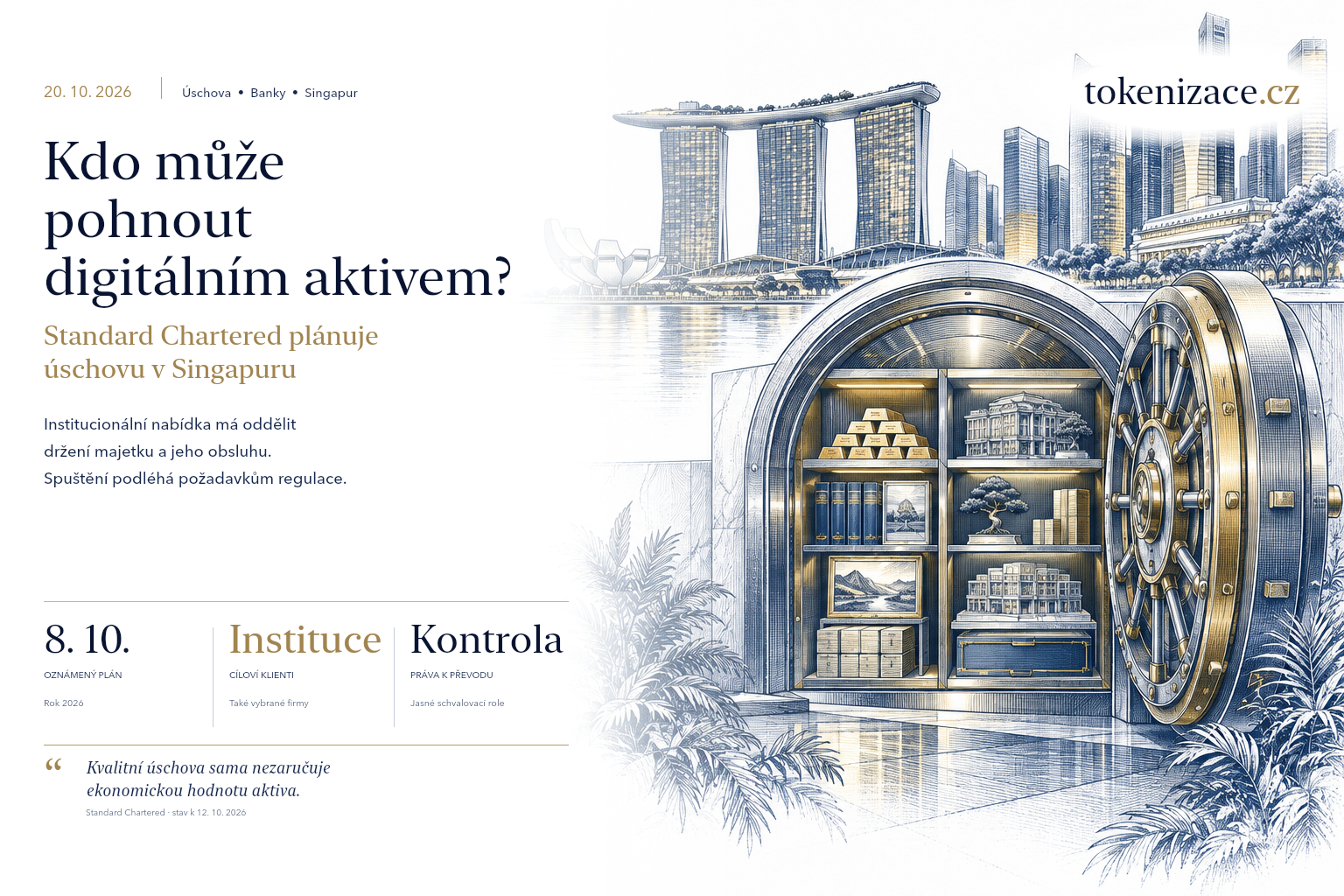
The bank intends to expand services for institutional clients and selected corporate investors. For a business owner, the important point is how authority is divided between the asset owner, the access administrator and the person approving a transfer.
Summary for readers
- Standard Chartered has announced its intention to offer digital custody in Singapore.
- Launch remains subject to applicable regulatory requirements; this is not an announcement of a generally available service.
- Safe custody of an asset and its economic quality are two separate questions.
A banking plan for a defined group of clients
According to the announcement of 8 October, the Singapore offering is to cover selected cryptoassets, stablecoins and tokenized real-world assets. It targets institutions and corporate clients that meet the requirements for accredited investors. The bank places it within a broader expansion of digital services and plans links to financing and securities services. Standard Chartered announcement.
The announcement itself does not confirm completion of the regulatory process or contractual terms for a particular Czech company. It contains no universal promise to accept every token. Assessing the offering therefore still requires establishing exactly which assets are supported, which clients are eligible and when the service actually becomes available.
Custody begins with the allocation of authority
In a client interface, a digital asset may look like an ordinary portfolio item. Behind that simplicity, however, lies a sensitive decision: who can create an instruction and who can turn it into an irreversible transfer. Our editorial analysis therefore focuses on the approval chain, rather than on the appearance of the wallet itself.
A hypothetical company might separate payment preparation from approval. One person submits the request; another checks its purpose and recipient. The system administrator should not acquire unlimited authority over business transactions merely because they can restore access. The precise implementation depends on the service and contract; it cannot be assumed for an announced product without documentation.
Three questions for exceptional situations
The first question concerns an error in an instruction. The company needs to know until what point a transfer can be stopped and whom to contact. The second concerns a change of personnel: how quickly a departing employee’s authority ends and how it can be demonstrated that they can no longer act. The third is an operational outage, during which it must be clear which activities continue and which wait.
These situations can easily disappear behind a general promise of security. A useful basis for a decision would be a demonstration of one normal transfer and one error, including the approval record. This does not assert that Standard Chartered lacks such controls. It describes a way for a customer to compare offerings.
A custodian does not eliminate asset risk
Even well-managed custody does not, by itself, guarantee the value of the instrument held. A company must separately assess the issuer, the underlying right, redemption options and any transfer restrictions. Alongside that, it evaluates the quality of the custodian’s service and the scope of its responsibility. Combining the two questions may create the mistaken impression that a well-known bank confirms the return or safety of every supported asset.
Implications for Czech and Slovak companies
The announcement primarily signals that banks are preparing broader institutional services for digital assets. For a local business, it is not an automatic invitation to open an account. A practical step is to map its own authority: who may decide on an investment, who executes the transfer, who approves it and who independently checks the records.
Such a map is useful even before selecting a provider. It makes it possible to ask precise questions and distinguish between a function the service offers and a responsibility the company must continue to bear.
Sources
Methodological note
This article distinguishes institutional announcements from the editorial team’s own analysis. The sources include direct material about the event and background on the topic; their inclusion does not mean that they all describe the same transaction. The examples and questions for companies are the author’s interpretation, not findings about a particular client. The planned publication date does not advance the cutoff date for verification of the sources.
Disclaimer
This text is for information and education. It does not constitute investment, legal, tax or accounting advice or an offer of a financial service. Any application requires an individual assessment. The institutions mentioned are neither partners nor guarantors of Tokenizace.cz.
What this means for you
AI puts the article in the context of your role, company and industry. Choose the one working document you need now.
Saved outputs and notes are private. Making your profile public does not share them with other users.
Loading account…
Context and outlook
Loading…
Open the full category →Comments
No comments yet. Be the first!