The IMF examines the growth of tokenization. Faster finance needs liquidity ready for use
The IMF analyses benefits and vulnerabilities as tokenization scales up, describing current systemic risks as limited. For a company, transfer speed needs to be matched by the availability of funds and responsible operational support.
Take the full article to your ChatGPT, Claude or Gemini and explore what it means for your work.
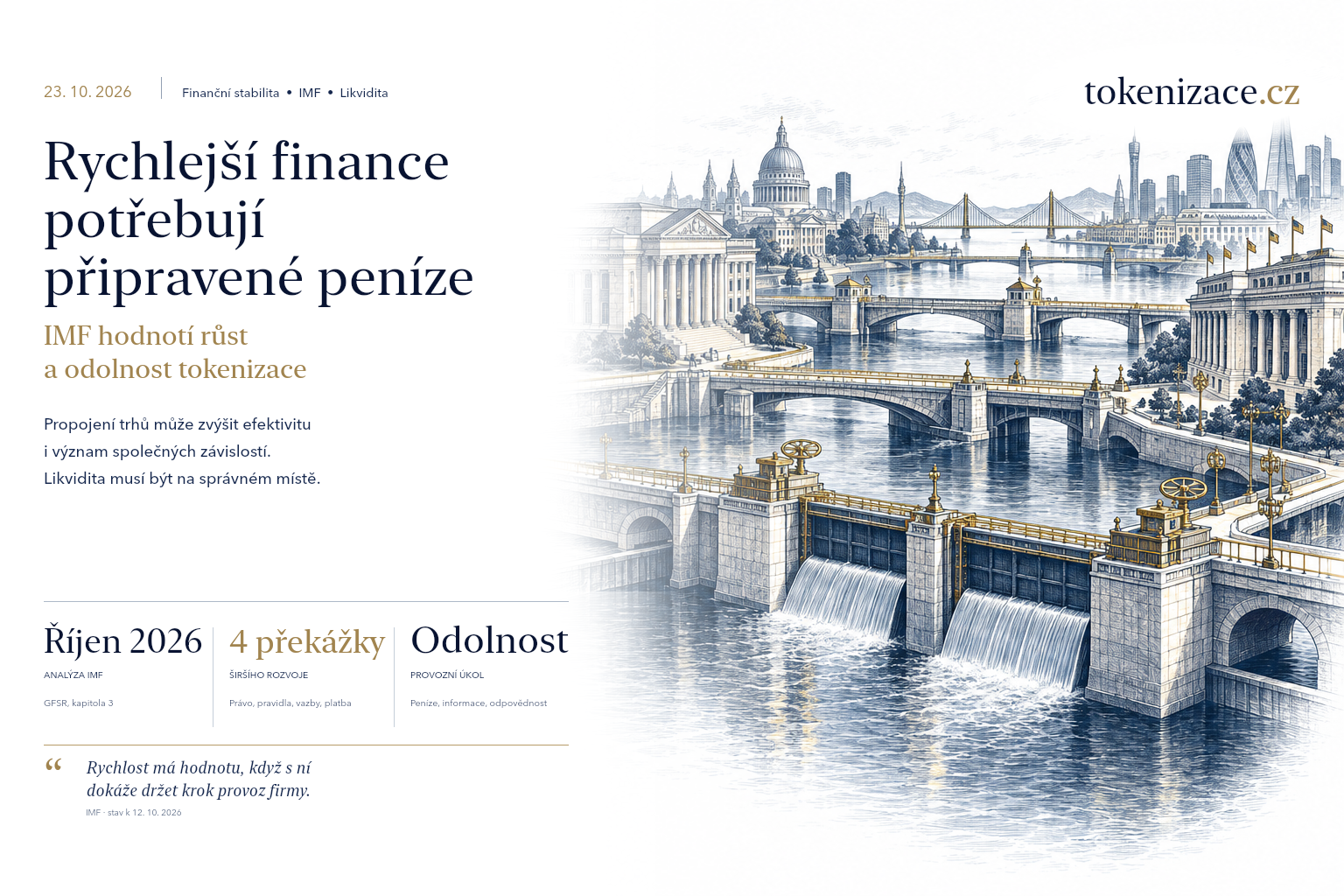
Tokenization can improve the servicing of financial assets. The International Monetary Fund’s October analysis also explains why growing interconnected markets place greater demands on resilience.
Summary for readers
- The IMF assesses benefits and vulnerabilities as tokenization gradually scales up.
- It describes current systemic risks as limited; it is not presenting an account of an ongoing tokenization crisis.
- For a company, transfer speed needs to be matched by the availability of funds and responsible operational support.
Growth changes the importance of individual connections
The chapter Scaling Tokenization: New Efficiencies, New Vulnerabilities describes an environment that remains relatively small and fragmented. It identifies legal certainty, regulatory clarification, interoperability and the availability of settlement assets among the constraints on wider use. Network effects can deliver greater benefits, while also increasing the importance of connections between participants. IMF, chapter 3, especially pp. 43–46.
The analysis does not say that every move of an asset to a digital register automatically increases danger. It points to the difference between an isolated use and an environment in which a larger part of the market relies on the same infrastructure. Today’s limited scale of risk therefore does not replace preparation for further growth.
Speed changes the management of reserves
Faster settlement can benefit a business: it learns sooner whether a transaction has completed and can plan subsequent activities more precisely. At the same time, there is less room to find additional funds or correct an error afterwards. The editorial question is therefore whether the company can keep pace with the speed its infrastructure enables.
A hypothetical supply chain may require payment immediately after delivery is confirmed. The company has sufficient assets, but currently holds its money in another account. The technical ability to make an immediate payment does not, by itself, bridge the gap between total asset value and funds available in the right place.
One shared dependency can affect several services
A company may use several differently named applications that nonetheless rely on the same custodian, data source or payment connection. The customer may not immediately recognise their shared operational dependency. More interfaces do not yet mean more independent routes.
A concise map of key connections would therefore help when selecting a solution. Who confirms the asset’s status? Who handles payment? Which institution can restore access? How can divergence between records be detected? The answers are more valuable than a general assertion that a service operates around the clock.
What continuous operation means for a small company
Available technology does not necessarily mean an available person authorised to deal with an exceptional situation. A business must therefore choose which operations it genuinely needs outside working hours and which should wait for a check. Time and amount limits can be sensible parts of a specific operating design.
For Czech and Slovak companies, the first benefit may be better records and less manual reconciliation. That benefit can be verified without promising that the whole business will move to continuous financial operations. The extent of the change should follow its needs and its capacity to operate the service.
The IMF’s October chapter offers a framework for a measured assessment: consider efficiency and resilience together. For an individual company, this becomes a concrete task—verify that, as assets move faster, money, information and a responsible person remain available.
Sources
Methodological note
This article distinguishes institutional announcements from the editorial team’s own analysis. The sources include direct material about the event and background on the topic; their inclusion does not mean that they all describe the same transaction. The examples and questions for companies are the author’s interpretation, not findings about a particular client. The planned publication date does not advance the cutoff date for verification of the sources.
Disclaimer
This text is for information and education. It does not constitute investment, legal, tax or accounting advice or an offer of a financial service. Any application requires an individual assessment. The institutions mentioned are neither partners nor guarantors of Tokenizace.cz.
What this means for you
AI puts the article in the context of your role, company and industry. Choose the one working document you need now.
Saved outputs and notes are private. Making your profile public does not share them with other users.
Loading account…
Context and outlook
Loading…
Open the full category →Comments
No comments yet. Be the first!